AI Won't Take Your Job. But It Will Change It.
AI jobs Malaysia: 697,000 roles face disruption, but fewer than 5% are fully automatable. What CEOs should do — and the reskilling schemes already paid for.

🕰️ We Have Had This Exact Panic Before
Picture a Malaysian office in 1985.
Someone has just wheeled in a personal computer. Half the room is fascinated. The other half is quietly updating their CV, because the typing pool can see exactly where this is going.
They were right, by the way. The typing pool did go.
What they got wrong was the second half of the sentence. The work did not disappear — it moved. It moved up, into spreadsheets, databases, systems administration, and eventually into an entire industry that did not exist when that machine was unboxed. The people who learned the box did fine. Some did extraordinarily well.
Forty years later, we are running the same experiment with a faster machine and a shorter fuse.
And the honest answer for any CEO reading this is not "relax, nothing will change." It is this: some of your roles will not survive the next three years in their current shape. Almost none of your people need to be replaced. Those are two very different problems, and most boards are solving the wrong one.
📉 First, the Part Nobody Puts on the Town-Hall Slide
Symprio's position is that AI is a workforce opportunity for Malaysia. That position is worth nothing if we skip the uncomfortable data, so here it is.
The labour market is not shrinking evenly. It is splitting.
Malaysia's Human Resources Minister told the Dewan Rakyat in June 2026 that 697,000 jobs are highly vulnerable to technological and economic transformation if workers do not reskill within three to five years (Source: Malay Mail)
ISIS Malaysia research indicates 45% of the workforce — roughly 6.7 million workers — have at least 40% of their tasks exposed to change (Source: TalentCorp)
Globally, the WEF expects 92 million roles displaced by 2030 (Source: Malay Mail on the WEF Future of Jobs Report)
There is a subtler effect that shows up in no redundancy statistic at all. AI is currently suppressing hiring more than it is destroying employment — companies are deploying it to avoid adding headcount, which means the roles that would have existed simply never get posted. Entry-level hiring is reported to have fallen sharply while AI and machine-learning hiring climbed (Source: Value Add VC analysis).
Translation for the boardroom: the bottom rung of the career ladder is being quietly sawn off. If your organisation stops hiring juniors this year, you will be buying senior talent at a premium in 2031.
So — that is the bad news, stated plainly. Now the rest of the picture.
📊 The Number That Reframes Everything

Here is what almost never makes the headline.
What the data actually says | Figure |
|---|---|
Roles displaced globally by 2030 | 92 million |
New roles created globally by 2030 | 170 million |
Net change | +78 million |
Businesses expecting AI to transform them by 2030 | 86% |
Core job skills expected to change by 2030 | 39% |
Occupations fully automatable with current technology | under 5% |
Occupations with partial task exposure | around 60% |
(Sources: Malay Mail / WEF Future of Jobs Report; Sustainability Magazine; Value Add VC)
Read the last two rows again, because they are the entire argument.
Fewer than one job in twenty can be fully automated. Roughly six in ten will be partially restructured. That is not a replacement wave. That is a re-composition wave — tasks moving out of a role and different tasks moving in, while the person stays.
Which is exactly what the personal computer did to the accounts department in 1990. Nobody stopped doing accounting. They stopped doing arithmetic.
🔬 Why AI Structurally Cannot Do the Whole Job
This is not optimism. It is a property of how these systems work, and 2026 gave us three unusually clean demonstrations of it.
In September 2026, OpenAI announced that roughly 10,000 coordinated agents, running for 88 hours and consuming about 130 billion output tokens, produced a resolution to the Navier–Stokes Millennium Prize problem — subsequently formalised in Lean (Source: OpenAI). Extraordinary. It is also still being independently scrutinised, and OpenAI has said it does not intend to claim the prize (Source: Axios).
In August 2026, Stanford and the Arc Institute used genome language models to design bacteriophages from scratch. They generated close to 700,000 candidate genomes. Of those, 285 were synthesised and 16 produced viable phages (Sources: Stanford Report; CGTN).
In materials science, DeepMind's GNoME predicted 2.2 million crystal structures. External laboratories have physically synthesised 736 (Source: arXiv).
Notice the shape.
System | Options generated | Survived contact with reality |
|---|---|---|
Genome design | ~700,000 | 16 |
Materials discovery | 2,200,000 | 736 |
Mathematical proof | ~10,000 agents | 1 result, still under review |
AI has become superb at one thing: widening the space of things worth trying. Deciding which of them is actually true, safe, legal, affordable, and worth building is a different job — and it is a job that just got much bigger, not smaller.
Every one of those funnels has humans at the narrow end. That narrow end is where the 170 million roles come from.
✈️ A Test Case Sitting on Our Own Doorstep
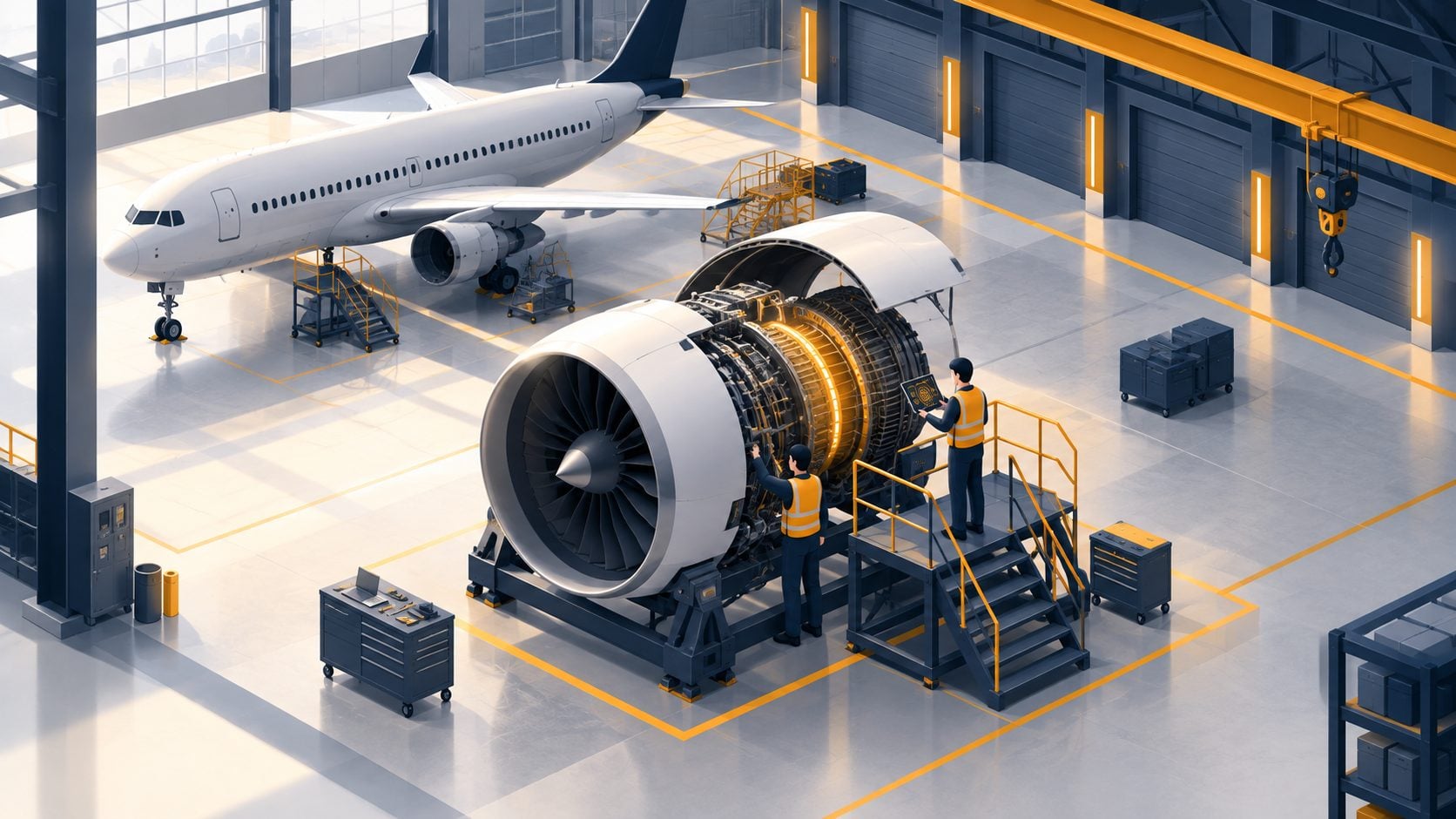
If you want proof that AI does not simply absorb work, look at Malaysian aviation.
Ocean Infinity ended its most recent MH370 search on 23 January 2026. Since 2018 the company has spent 151 days at sea and mapped more than 140,000 square kilometres of seafloor using the most advanced autonomous underwater technology it has ever deployed, supported by machine-learning analysis of sonar data. It found nothing (Source: Ocean Infinity). The Malaysian Cabinet has extended the agreement to 30 June 2027 (Source: The Diplomat).
Meanwhile the industry's most expensive operational problem is not a software problem at all. Around 720 of 1,912 Pratt & Whitney-powered A320neo-family aircraft have been out of service — caused by contaminated metal powder in turbine and compressor discs, with engine shop visits stretching to 250–300 days instead of the usual 60–90 (Source: Airmappr).
No model fixes metallurgy. No model builds a hangar bay.
And yet aviation is also where applied AI is producing hard numbers. American Airlines' AI gating at Dallas/Fort Worth cut taxi times by over a minute per flight — eliminating up to 10 hours of taxi daily and saving 870,000 gallons of jet fuel a year. Assaia's turnaround AI at Rome Fiumicino cut ground delays 6%. Textron's maintenance assistant reduced troubleshooting from 20 minutes to one or two (Source: OAG & Microsoft).
None of those replaced the gate planner, the ground crew, or the licensed engineer. All of them made those people dramatically more valuable — which is precisely why the global shortage is of people: around 12,800 aircraft mechanics short in North America alone, and 674,000 new pilots needed over twenty years (Source: OAG & Microsoft).
The lesson is not that AI is overrated. The lesson is that AI moves the constraint from labour to capability — and capability is something you build in people.
Malaysia's Real Problem Is Not Too Few Jobs

Here is the uncomfortable inversion at the heart of the AI jobs Malaysia debate.
The same TalentCorp impact study that flagged 697,000 vulnerable roles also identified 120 emerging roles becoming increasingly important to the economy (Source: MokaHR summary of TalentCorp study). Meanwhile, Malaysia has only a few thousand genuine AI professionals against a need in the tens of thousands by 2030 (Source: State of AI in Malaysia 2026).
Sit with that for a second.
We are not facing a country with too many workers and not enough jobs. We are facing a country with positions it cannot fill and workers it has not yet moved.
That is a logistics problem. Logistics problems are solvable — and unlike a turbine disc, they are solvable by decisions a CEO can make this quarter.
🎓 The Reskilling Infrastructure Is Already Built and Already Paid For

This is the part most Malaysian executives genuinely do not know, and it is the most actionable section in this post.
Malaysia has spent two years building a national AI reskilling stack. Most companies have not touched it.
Layer 1 — National AI literacy, free. AI Untuk Rakyat, run by MyDIGITAL Corporation with Intel, was completed by over one million Malaysians in under six months after its January 2024 launch (Source: MyDIGITAL). The 2026 edition runs on the Rakyat Digital portal with a far deeper module list — including Generative AI, AI Security, Agentic AI for All and Cloud — and the Ministry of Digital states the courses are free to all Malaysian citizens, with certificates on completion. Malaysians aged 18 to 30 who complete the designated modules also receive a three-month free subscription to selected AI software, with a target of 100,000 participants through 2027 (Source: The Star).
Layer 2 — Benchmarking and pathways. TalentCorp's MyMahir platform maps roles, required skills and training pathways against emerging occupations. In January 2026 TalentCorp and EY launched Jelajah AI MyMahir, an RM110 million nationwide rollout reaching 60 constituencies and around 22,000 Malaysians (Source: TalentCorp). Graduates of the MyMahir SkillsLab programme are expected to secure starting salaries 5% to 15% above the average entry-level wage (Source: People Matters).
Layer 3 — Hands-on, levy-funded. Approved corporate AI training is claimable through HRD Corp's SBL-KHAS scheme, which means an eligible employer can put a team through instructor-led training funded largely by a levy they are already paying.
Layer 4 — Applied capability, taught by people who ship. This is the layer Symprio operates in. As a certified training partner we run hands-on programmes in AI and GenAI, RPA, and corporate workshops — covering agentic AI, vibe coding with Cursor and Claude Code, n8n orchestration, and automation Centre-of-Excellence enablement. Our courses are taught by the same engineers who deliver production systems, which is the entire point: your team learns on the architecture they will actually run.
Now the honest caveat, because this matters: literacy is not capability. Finishing a four-hour module does not make anyone able to ship a production agent, and treating it as though it does is how organisations end up with an enthusiastic workforce and no working systems. Free programmes get your whole company to the start line. They do not get you across it.
But here is the CEO arithmetic. Layer 1 costs you nothing. Layer 2 costs you nothing. Layer 3 costs you money you have already remitted. Baseline AI literacy across your entire organisation is close to a free option — and most Malaysian companies still have not exercised it.
So do two things this quarter, in this order.
One: send every employee to rakyatdigital.gov.my this month and give them the working hours to finish it. It costs you nothing but calendar time, and it tells you something no assessment will — which of your people lean in when nobody is forcing them.
Two: take the twenty who lean in and put them through real, instructor-led training pointed at a system you actually intend to build. That is where Symprio comes in, and where your HRD Corp levy stops being a line item and starts being a capability budget.
Talk to us about training your team →
💎 The Symprio Approach: Build the Capability, Not the Dependency

Symprio builds AI products for clients in BFSI and regulated industries — and operates its own product portfolio. Which means we watch this workforce question play out inside real delivery programmes, not in survey data. Four principles guide how we handle it.
Automate the task, promote the person. Every engagement starts by decomposing a role into tasks, not by asking which headcount disappears. The fewer-than-5%/60% split in the data is a design instruction: find the 60% of a job that is repetitive judgement, route it to an agent, and give the human the escalations. That is how you get adoption instead of quiet sabotage.
Govern from day one. Deployments aligned to BNM expectations, PDPA and AIGE from the first sprint, with sovereign-cloud options where data residency demands it. Workforce trust and regulatory trust are the same asset — people cooperate with systems they can see the rules for. Explore our agentic AI products and platforms →
Co-build so the capability stays. Our adopt-and-build model pairs Symprio engineers with your team, transfers the architecture, and certifies your people to run it. The point is not that we leave. The point is that when we do, your organisation has five more people who can build the next one. See how we approach AI development →
We will train your people ourselves. Symprio is a certified training partner, and our academy runs hands-on programmes in AI and GenAI, agentic systems, vibe coding, n8n and RPA — delivered as public cohorts or closed corporate workshops, and structured to be HRD Corp-claimable for eligible Malaysian employers. We help clients sequence national programmes, levy-funded training and MDEC grants against an actual delivery roadmap, so reskilling is attached to a product being shipped rather than a certificate being collected. Training that isn't pointed at a real system is a cost. Training attached to a live build is an investment with an observable return. Explore Symprio training and workshops →
💬 Over to You
Where is your organisation on this curve?
Still treating AI as an IT procurement question rather than a workforce question?
Quietly freezing junior hiring, without a plan for where your 2031 seniors come from?
Sitting on an HRD Corp levy balance while your competitors' teams get certified?
These are exactly the conversations Symprio has with Malaysian boards every week.
🎓 We'll Upskill Your Team
You do not have to hire your way out of this. In most Malaysian organisations, the people who will run your AI systems in 2028 are already on your payroll — they have simply never been taught.
Symprio's academy exists for exactly that. Certified training partner, taught by engineers who ship production systems, structured for HRD Corp claims, and available as open cohorts or a closed programme built around your own stack and use cases.
👉 AI & GenAI Training → — agentic AI, vibe coding, LLM application design
👉 RPA Training → — UiPath, Power Automate, CoE enablement
👉 Corporate Workshops → — run in-house, built around your processes
📞 Let's Build Something Real
Stop treating AI as a threat to your headcount. It's time to build an organisation where AI makes your people more expensive to replace — not the other way round.
Reach out to the Symprio team today and let's map which roles in your operating model change first, what your team needs to learn, and what we build together first.
👉 Book a 30-minute discovery call → — no slide deck, just whiteboard thinking
👉 Explore our Agentic AI products & platforms →
👉 Read related: Your AI Pilot Was the Cheap Part →
❓ FAQ: AI and Jobs in Malaysia
Will AI take my job in Malaysia?
For most people, no — but the job will change. Fewer than 5% of occupations are fully automatable with current technology, while around 60% have partial task exposure. Malaysia's Human Resources Ministry has flagged 697,000 roles as highly vulnerable if workers do not reskill within three to five years.
How many jobs will AI create versus destroy?
The World Economic Forum projects 92 million roles displaced globally by 2030 and 170 million new roles created — a net gain of roughly 78 million. The difficulty is not the net number but the transition: the people losing roles are rarely the same people filling the new ones.
What free AI training is available in Malaysia?
AI Untuk Rakyat, run by MyDIGITAL Corporation with Intel, is free to all Malaysian citizens through the Rakyat Digital portal and has been completed by over one million Malaysians. TalentCorp's MyMahir platform maps skills and pathways, and Jelajah AI MyMahir is an RM110 million nationwide upskilling rollout.
Can Malaysian employers claim AI training costs?
Yes. Approved corporate AI training is claimable through HRD Corp's SBL-KHAS scheme, allowing eligible employers to fund instructor-led training largely through their existing levy contributions rather than new budget.
Does Symprio provide AI training for companies?
Yes. Symprio is a certified training partner running hands-on programmes in AI and GenAI, agentic systems, vibe coding, n8n and RPA, plus corporate workshops delivered in-house around a client's own processes. Programmes are structured to be HRD Corp-claimable for eligible Malaysian employers.
What should a CEO do about AI and workforce planning right now?
Three things: put the whole organisation through free national AI literacy training, identify the 60% of tasks in each role that can be routed to agents rather than eliminating the role, and attach funded hands-on training to a live product build so capability is measurable rather than theoretical.
📚 Sources & Further Reading
Malay Mail — 697,000 roles at risk from AI without urgent upskilling
TalentCorp — RM110 Million Jelajah AI MyMahir Expands Nationwide
MyDIGITAL — One Million Malaysians Complete 'AI Untuk Rakyat'
The Star — AI for the People participants to complete six modules for free AI tools
People Matters — Malaysia faces AI-driven workforce shift as 697,000 jobs at risk
Sustainability Magazine — WEF report on 170m new jobs by 2030
Axios — OpenAI's historic math solution overshadowed by credit controversy
CGTN — AI used to design novel bacteriophage genomes in the lab
arXiv — AI for Scientific Discovery is a Social Problem (GNoME synthesis figures)
OAG & Microsoft — AI and Trusted Data: Building Resilient Airline Operations
#Symprio #EnterpriseAI #FutureOfWork #AIStrategy #AgenticAI #DigitalTransformation #Malaysia
Symprio builds AI products that make teams more capable — not smaller. Find us at symprio.com.