The audio edition couldn't be loaded right now — the written post below has everything.
The pilot is the cheap part. Break down the AI total cost of ownership — build, run, govern, people — and see how Malaysian teams keep it under control.
💸 The Demo Was Free. The Ownership Isn't.
Everyone can afford an AI demo.
Almost nobody budgets for the AI product.
That gap has a name — AI total cost of ownership — and it's quietly killing more AI initiatives than bad models ever will. The receipts are brutal:
95% of enterprise GenAI pilots deliver no measurable P&L impact (Source: MIT NANDA, via Forbes)
30% of generative AI projects were predicted to be abandoned after proof of concept by end-2025 (Source: Gartner)
42% of enterprises scrapped most of their AI initiatives in 2025 — up from just 17% a year earlier (Source: S&P Global Market Intelligence, via WitnessAI)
Here's what most people miss: those projects mostly didn't die because the AI was bad.
They died because someone priced the demo — and nobody priced the ownership.
🧾 The Price Tag Nobody Puts on the Slide
A pilot takes three weeks and a corporate card. Production is a different postcode.
Gartner puts the real cost of deploying generative AI at US$5 million to US$20 million depending on the approach — before you count the humans, the governance, or the year-two bills (Source: Gartner). Their analyst Rita Sallam said the quiet part out loud: "there is no one size fits all with GenAI, and costs aren't as predictable as other technologies."
Translation for the boardroom: the number on the vendor's slide is the entry fee, not the price.
And the projects that do get through? Gartner predicts over 40% of agentic AI projects will be cancelled by end-2027 — with escalating costs listed as a top reason (Source: Gartner).
So let's do what the slide deck won't. Let's look under the waterline.
🧊 The AI Total Cost of Ownership Iceberg: Four Layers Down

Every AI product you'll ever own has four cost layers. The demo shows you one.
Layer 1 — Build. The visible bit. Licences, development, data pipelines, integration with the systems that actually run your business. This is the only layer most business cases price properly.
Layer 2 — Run. Inference bills, cloud infrastructure, monitoring, evaluation, model upgrades, and the retrieval plumbing that keeps answers grounded. This layer recurs forever — and as you'll see below, it has a habit of growing.
Layer 3 — Govern. Access controls, audit trails, PDPA compliance, alignment with Malaysia's AI governance expectations (AIGE), security reviews, incident response. Skip it and the layer doesn't disappear — it converts into breach costs and regulator conversations.
Layer 4 — People. Training, change management, new roles, and redesigning the workflow the AI now lives in. McKinsey's data is blunt on this one: only 39% of organisations see any EBIT impact from AI, and the ones that do are those that fundamentally redesigned workflows — high performers are three times more likely to have done it (Source: McKinsey State of AI).
Four layers. One number. That's your real AI total cost of ownership.
📉 "But Isn't AI Getting Cheaper?" — Yes. And Your Bill Is Going Up.

This is the plot twist that catches every finance team.
Token prices are in freefall. The cost of frontier-level intelligence has dropped roughly tenfold per year — from about US$60 per million tokens in 2021 to around US$0.06 today (Source: EpochAI, via Forbes). Gartner expects inference on a trillion-parameter model to cost over 90% less by 2030 than it did in 2025 (Source: Gartner).
So why do AI bills keep climbing? Because usage is climbing faster.
The tug-of-war | The number | Direction |
|---|---|---|
Price per million tokens | US$60 (2021) → ~US$0.06 (2026) | 📉 Falling |
Inference cost, 1T-parameter model | −90% by 2030 vs 2025 | 📉 Falling |
Tokens consumed per agentic task vs a chatbot | 5–30× more | 📈 Rising |
Google's monthly token consumption | 9.7 trillion (2023) → 3.2 quadrillion (2026) | 📈 Rising |
Enterprises abandoning most AI initiatives | 17% (2024) → 42% (2025) | 📈 Rising |
(Sources: Forbes; Gartner; WitnessAI)
Gartner analyst Will Sommer's warning deserves a spot on your wall: "do not confuse the deflation of commodity tokens with the democratization of frontier reasoning." Agentic systems — the ones that plan, call tools, and check their own work — burn 5–30× the tokens of a simple chatbot.
In plain English: unit price down, unit consumption way up. Your TCO doesn't care which one made the headlines.
🇲🇾 The Malaysian Math
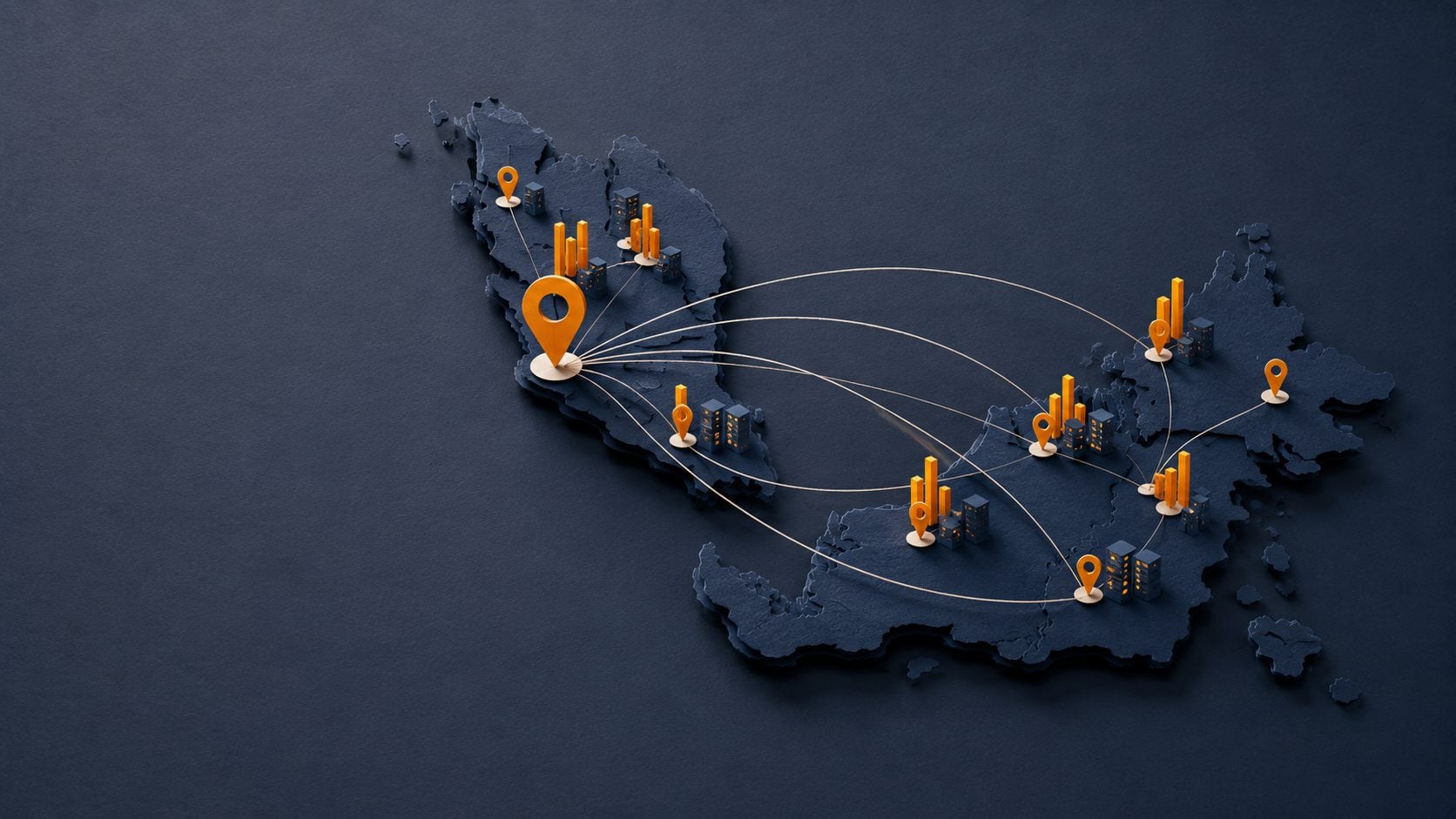
Now zoom into our corner of the map, because the stakes here are real money.
Malaysia secured RM87.4 billion in AI-driven digital investments in 2025 alone, and the digital economy is on track to hit 30% of GDP by 2030 under the AI Nation 2030 agenda (Source: The Edge Malaysia). A National AI Office now exists. The PDPA has been amended. The Data Sharing Act is live.
There's even help with the build layer: MDEC's Malaysia Digital Acceleration Grant for AI (MDAG-AI) co-funds up to 70% of project cost, capped at RM2 million, for qualifying AI development (Source: MDEC) — application windows open and close, so watch for the next cycle.
But here's the catch nobody prints on the grant poster:
Grants subsidise the build. Nobody subsidises the run.
Layers 2, 3 and 4 — inference, governance, people — stay on your P&L for the life of the product. Which is exactly why Malaysian boards should be the most TCO-literate in the region: the money flowing in is real, and so is the ownership tail behind every ringgit of it.
🚨 Where the Money Actually Leaks
Ready for the uncomfortable list? These are the leaks we see most — and the data backs it up.
Shadow AI. 68% of employees access GenAI through personal accounts, and 57% admit to pasting confidential information into public tools (Source: TELUS Digital, via WitnessAI). IBM prices the consequence: organisations with heavy shadow AI paid a US$670,000 premium per breach versus those without (Source: IBM Cost of a Data Breach 2025, via WitnessAI). That's a Layer-3 cost you're paying whether you budgeted it or not.
Agent washing. Vendors are rebranding chatbots and RPA scripts as "agents." Gartner estimates that of thousands of self-declared agentic AI vendors, only about 130 are the real thing (Source: Gartner). Buying the wrong "agent" means paying twice — once for the licence, once for the replacement.
The pilot graveyard. 46% of AI proofs of concept never reach production (Source: S&P Global, via WitnessAI). Every abandoned pilot is 100% cost, 0% return — the worst TCO ratio in technology.
The forever-consultant model. The subtlest leak of all. If every enhancement, every prompt tweak, every new use case needs an external team, you don't own an AI product. You're renting one — indefinitely.
The lesson is not that AI is a money pit. The lesson is that unowned AI is a money pit.
💎 The Symprio Approach: Own the Asset, Not the Invoice

Symprio builds AI products — for clients and in our own portfolio — and we advise on the architecture underneath them. TCO discipline is baked into how we work. Four principles guide it.
Price the workflow, not the model. The EBIT winners in McKinsey's data are the ones who redesigned workflows, not the ones who bought the shiniest model. We scope every AI product around one workflow with a measurable owner and a baseline cost — so ROI is an observable fact, not a slideware estimate.
Size the run cost before writing code. Routing matters more than model choice: routine tasks go to small, cheap models; frontier reasoning is reserved for the moments that earn it. Architecture decisions made in week one set your inference bill for years — we make them deliberately, in the open, with our composable enterprise architecture practice →.
Co-build so the capability stays when we leave. Our adopt-and-build model pairs Symprio engineers with your team, transfers the architecture, and certifies your people to run it. Combined with our vibe coding practice → — Cursor and Claude Code wrapped in enterprise-grade architecture — build costs compress and the forever-consultant leak closes for good.
Govern from day one, not after the audit. Sovereign-cloud deployment aligned to BNM expectations, PDPA, and AIGE from the first sprint. Retrofitted compliance is the most expensive kind — the IBM breach numbers above are what "we'll add governance later" actually costs. Explore our sovereign-cloud deployments →
🛠️ What a Sane TCO Looks Like in 90 Days
Within 90 days of engagement, teams typically see deployments such as:
A finance reconciliation agent that closes the month five days faster — run cost measured per close, not discovered per invoice.
An LHDN MyInvois e-invoicing middleware that delivers compliance without replacing your accounting stack.
An AML / fraud investigation acceleration agent that cuts case-handling time while keeping every action auditable.
An internal knowledge assistant trained on your SOPs — routed to small models, so the bill stays boring.
A customer-service triage agent with sentiment detection and escalation routing, sized to your actual ticket volume.
These are not moonshots. They're owned assets with known monthly costs — which is precisely what makes them fundable.
💬 Over to You
Where is your organisation on the AI cost curve?
Still comparing vendor slideware with no Layer 2–4 numbers?
Watching a pilot inch toward the 46% graveyard?
Paying a forever-consultant to babysit a product you thought you bought?
These are exactly the problems Symprio solves.
📞 Let's Build Something Real
Stop letting hidden ownership costs cap your AI ambitions. It's time to build AI products priced for ownership — sized to your reality, not a vendor brochure.
Reach out to the Symprio team today and let's put a real number on your AI total cost of ownership — then design the product that earns it back.
👉 Explore our Agentic AI products & platforms → 👉 Book a 30-minute discovery call → — no slide deck, just whiteboard thinking 👉 Read related: Built, Not Bought — The AI Product Imperative

❓ FAQ: AI Total Cost of Ownership
What is AI total cost of ownership?
AI total cost of ownership (TCO) is the full lifetime cost of an AI product across four layers: building it, running it (inference, infrastructure, monitoring), governing it (compliance, security, audit), and the people side (training, change management, workflow redesign).
How much does an enterprise AI product cost?
Gartner estimates generative AI deployments cost between US$5 million and US$20 million depending on approach, with costs less predictable than traditional software. Smaller scoped agentic products can cost far less — if run, governance, and people costs are designed in from day one.
Why do so many AI projects get cancelled?
Gartner predicts over 40% of agentic AI projects will be cancelled by end-2027, citing escalating costs, unclear business value, and inadequate risk controls. Most failures trace back to pricing the pilot instead of the full cost of ownership.
How can Malaysian companies reduce AI TCO?
Use co-funding like MDEC's MDAG-AI grant for the build layer, route workloads to smaller models to control inference costs, build governance for PDPA and AIGE from day one, and use a co-build model so capability transfers in-house instead of renting consultants indefinitely.
📚 Sources & Further Reading
Gartner — 30% of Generative AI Projects Will Be Abandoned After Proof of Concept by End of 2025
Gartner — Over 40% of Agentic AI Projects Will Be Canceled by End of 2027
Forbes — As Token Costs Plunge, Enterprise AI Providers Face a New Margin Squeeze
WitnessAI — The Hidden Cost of Enterprise AI: A 2026 Breakdown for CFOs (citing S&P Global Market Intelligence, IBM Cost of a Data Breach 2025, and TELUS Digital)
McKinsey — The State of AI: How Organizations Are Rewiring to Capture Value
The Edge Malaysia — AI Nation 2030 and Malaysia's Next Phase of Growth
MDEC — Malaysia Digital Acceleration Grant: Artificial Intelligence (MDAG-AI)
#Symprio #BuildNotBuy #EnterpriseAI #AIProducts #AgenticAI #AIStrategy #DigitalTransformation #Malaysia
Symprio builds AI products that are priced for ownership — not just for the demo. Find us at symprio.com.