Most Malaysian factories never finished Industry 4.0 — yet the world is already debating 5.0, and researchers are sketching 6.0. Here's the honest map of where we are and what's next."
Quick question. If someone asked which industrial revolution your business is actually living in right now — what would you honestly answer?
Most Malaysian manufacturers would say "we're working on 4.0." The candid ones would admit they're somewhere between 3.0 and 4.0: a few connected machines, a lot of spreadsheets. Meanwhile the global conversation — conferences, vendor decks, EU policy papers — has moved on to Industry 5.0. And in research labs, people are already writing about 6.0.
That gap is the story. We're being sold the fifth revolution before most of us finished buying the fourth. So the useful question isn't "is 5.0 coming?" It's: what does it mean, why does it matter for a country at 18% adoption, and what should you do on a Tuesday morning?
Five Revolutions, One Picture
Every revolution has a defining technology — and a defining shift in who does the work.
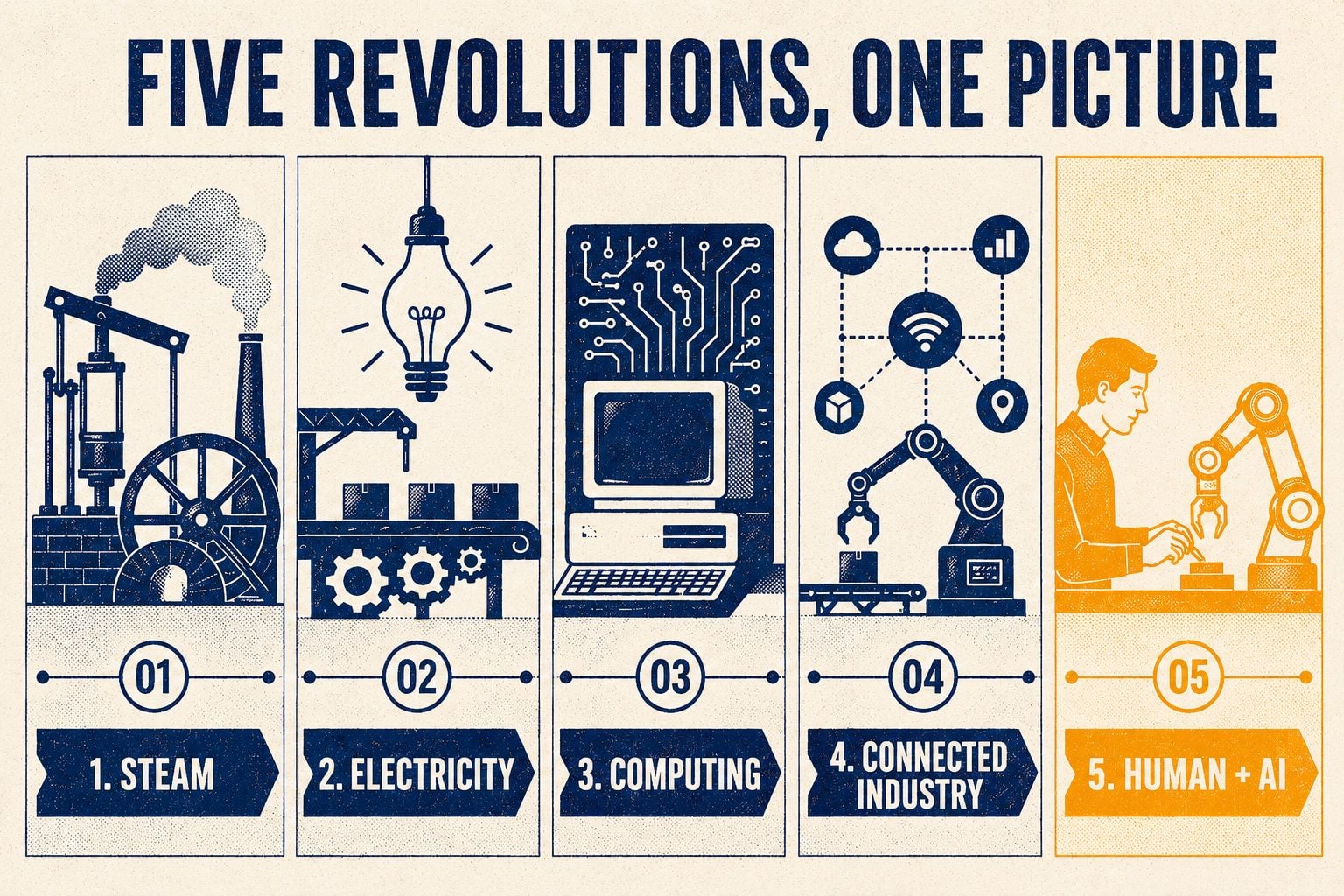
Era | When | Defining tech | The human's role |
|---|---|---|---|
1.0 | Late 1700s | Steam & water power | Operates the machine |
2.0 | 1800s | Electricity, assembly line | Works the line |
3.0 | Mid-1900s | Electronics, computers | Supervises automation |
4.0 | 2010s | IoT, AI, cyber-physical systems | Reads the dashboard |
5.0 | Now | Cobots, human-AI collaboration | Back at the centre |
Notice the drift: every revolution since 2.0 pushed humans further from the centre. Industry 4.0 was unapologetically machine-first — automation took centre stage, with big efficiency gains "but often at the expense of human involvement." (Source: Innovapptive)
But here's the thing most coverage misses: this isn't really about factory floors anymore. The same curve runs straight through automation and software — which is where most Malaysian enterprises actually live. Few of our readers run a smart factory; nearly all of them run processes, back-offices, and software systems. Translated to that world, the revolutions look like this:
Era | On the factory floor | In automation & software |
|---|---|---|
3.0 | Programmable machines | Scripts, macros, batch jobs |
4.0 | Connected smart factory | RPA bots, API integrations, workflow automation, dashboards |
5.0 | Cobots beside workers | Agentic AI beside the knowledge worker — copilots, human-in-the-loop decisions |
6.0 | Quantum, autonomous plants | Self-orchestrating software, hyper-personalised systems |
Read that 5.0 row again. The cobot of the office isn't a robot arm — it's an AI agent working next to a claims handler, a credit officer, an analyst. That reframing is the whole point of this post.
Industry 5.0 is the first revolution that deliberately reverses the dehumanising drift. But first — has anyone actually finished 4.0?
Is Industry 4.0 Even "Done"? Not Here.
Industry 4.0 isn't a finish line; it's a maturity curve. And in Malaysia, the numbers are sobering.
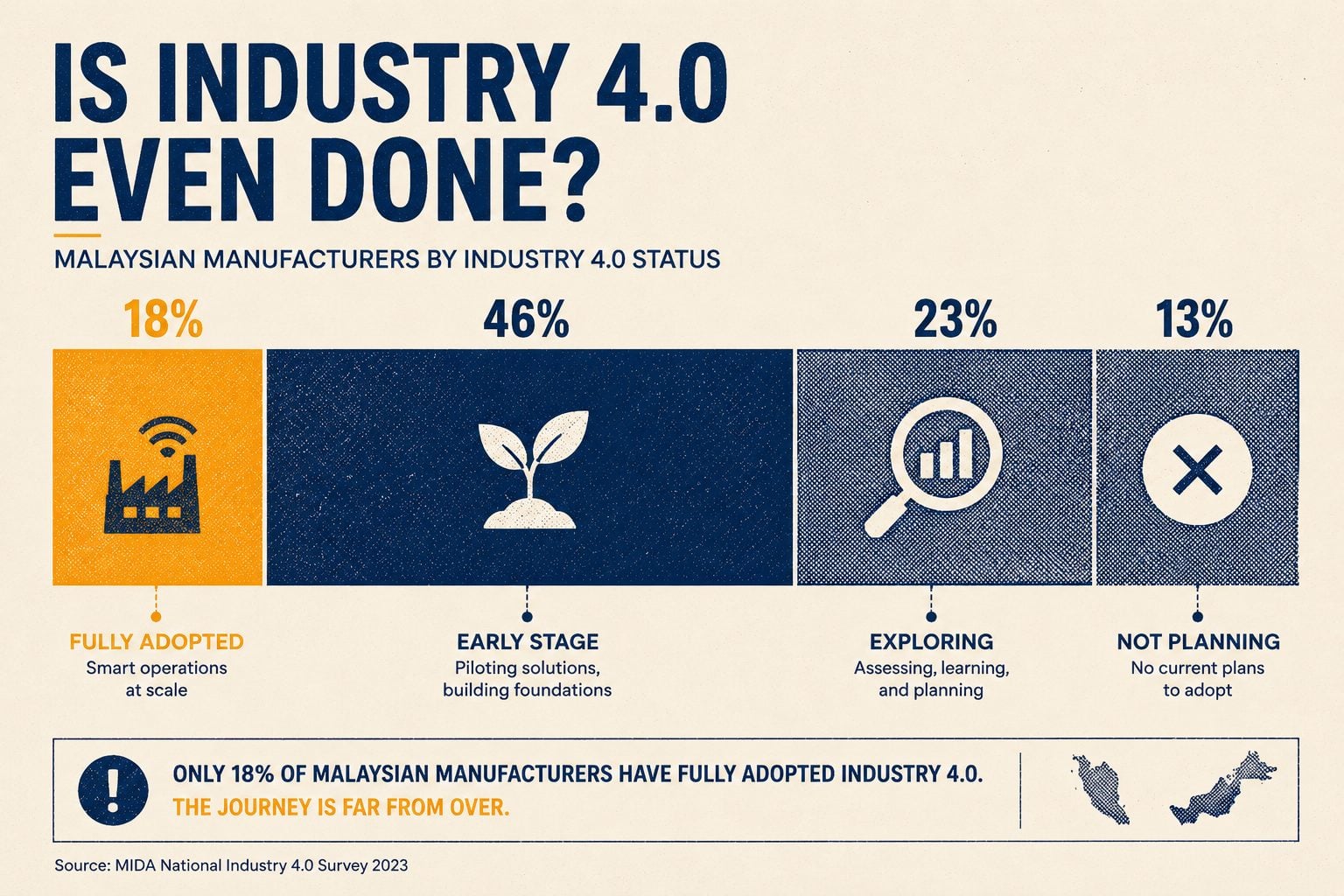
Only 18% of Malaysian manufacturers have fully implemented IR4.0 technologies. 46% are in early stages, 23% are exploring, and 13% don't plan to adopt at all. (Source: ScienceDirect)
Why so slow? Three reasons that compound:
The base is small. SMEs are 98.5% of manufacturing firms — the segment with the least capital tolerance for big transformation.
The barriers are stubborn. High upfront cost, talent shortage, low awareness of support. One estimate: even following every Industry4WRD recommendation, Malaysia would take ~12 years to reach developed-country level.
The scaffolding came down. The government's Industry4WRD Readiness Assessment — launched 2018 to assess SMEs — was discontinued as of 2025.
So when a vendor says 5.0 is "the future," the honest reply is: most of Malaysian industry hasn't captured the value of the present.
And the software side mirrors this exactly. Plenty of enterprises bought an RPA licence or a workflow tool and called it "digital transformation" — then left half the processes manual, the bots brittle, and the data still trapped in silos. That's a 4.0 purchase, not a 4.0 capability. The automation equivalent of the 18% gap is everywhere: a few bots running, a lot of copy-paste still happening underneath.
Where Malaysia Actually Stands
The policy machinery didn't stop — it changed shape. Industry4WRD has effectively folded into the bigger, mission-based New Industrial Master Plan (NIMP) 2030.
NIMP 2030 — what's on the table | Target |
|---|---|
Manufacturing value-added | +61% → RM587.5 billion by 2030 |
Smart factories | 3,000 under "Tech Up for a Digitally Vibrant Nation" |
Median manufacturing wage | +128% → RM4,510 (from RM1,976 in 2021) |
AI's role | "Key driver of innovation and productivity across industries" |
(Sources: MIDA, Selangor Techsphere, Digital Watch)
Read between the lines: Malaysia is trying to leapfrog. The wage and skills targets in NIMP 2030 are an Industry 5.0 idea wearing a 4.0 jacket — they treat the worker's value, not just machine throughput, as the goal. That makes the 5.0 conversation a planning input, not a luxury.
So What Is Industry 5.0, Precisely?
Not a slogan — a formal framework. The European Commission's 2021 white paper coined it and built it on three pillars.
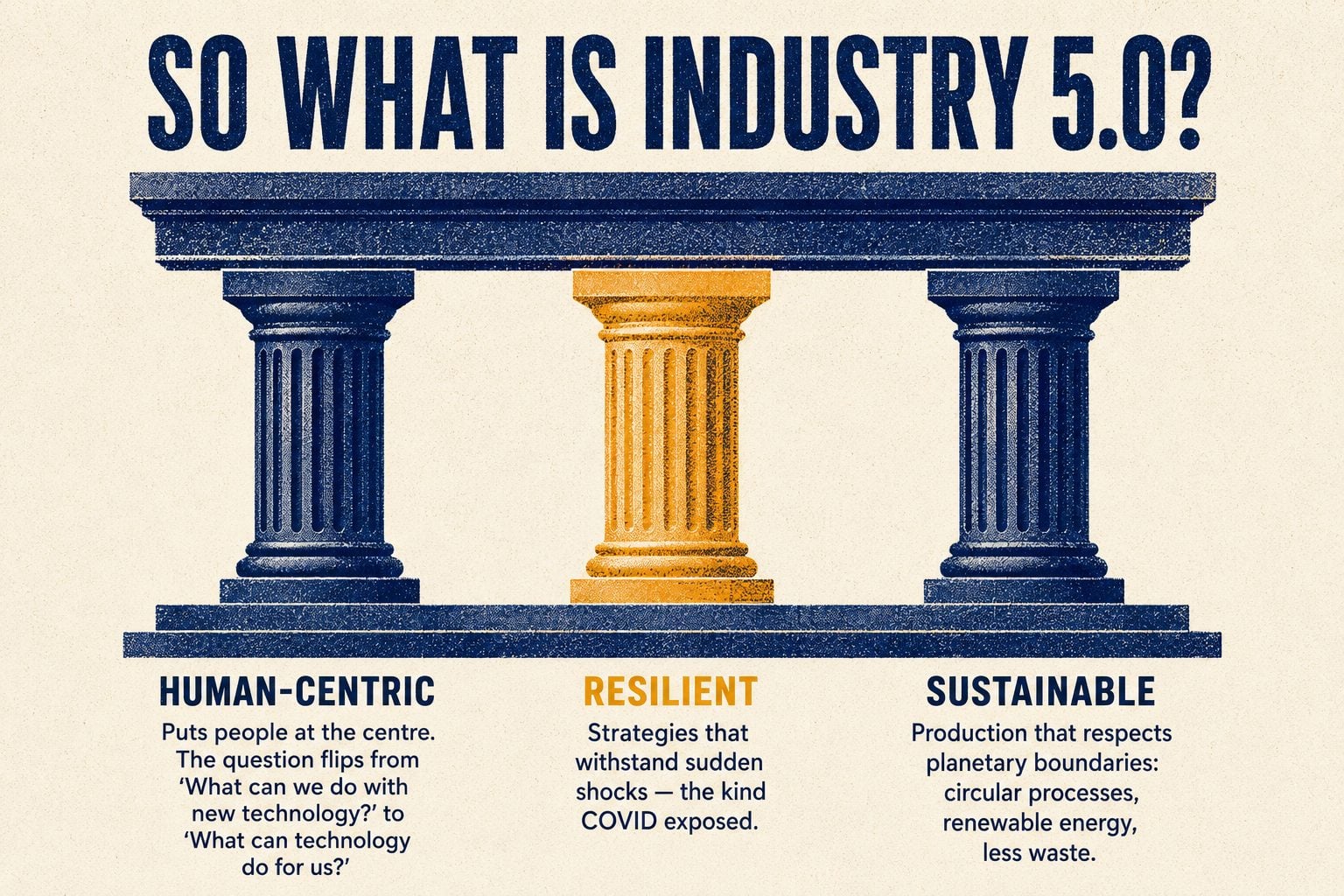
Human-centric. Puts people at the centre. The question flips from "What can we do with new technology?" to "What can technology do for us?"
Resilient. Strategies that withstand sudden shocks — the kind COVID exposed.
Sustainable. Production that respects planetary boundaries: circular processes, renewable energy, less waste.
(Source: European Commission)
The cleanest way to hold the difference: 4.0 built the factory's digital nervous system; 5.0 cares about the people working inside it. And the pillars reinforce each other — human judgement makes a system more resilient, because diverse human input improves adaptability. (Source: NeuroNomixer)
The Difference That Actually Matters
Dimension | Industry 4.0 | Industry 5.0 |
|---|---|---|
Defining question | What can we automate? | What can tech do for people? |
Centre of gravity | The machine & the data | The human & the outcome |
Value measured | Throughput, efficiency, uptime | Wellbeing, creativity, resilience |
Robots | Work alone, fenced off | Cobots work alongside |
AI's job | Optimise the process | Augment human judgement |
Scope | Mainly manufacturing | Every sector — finance, health, retail |
That last row is underrated. 5.0 "is not limited to industry" — it applies to every organisation. A bank, a hospital, an insurer all face the same question: how do humans and intelligent systems share the work? Which is exactly why 5.0 has landed on BFSI — its three pillars describe what regulators and risk teams already demand of financial services in 2026.
How AI Plays a Different Role in 5.0
AI is central to both 4.0 and 5.0 — but its job description changes. And nowhere is this clearer than in automation software, where you can watch the shift happen in real time:
4.0 automation = the rule-following bot. Classic RPA. It does exactly what you scripted — click here, copy that, paste there. Fast and tireless, but brittle: change the screen layout and it breaks. It optimises a process the human designed, then the human checks the output afterwards.
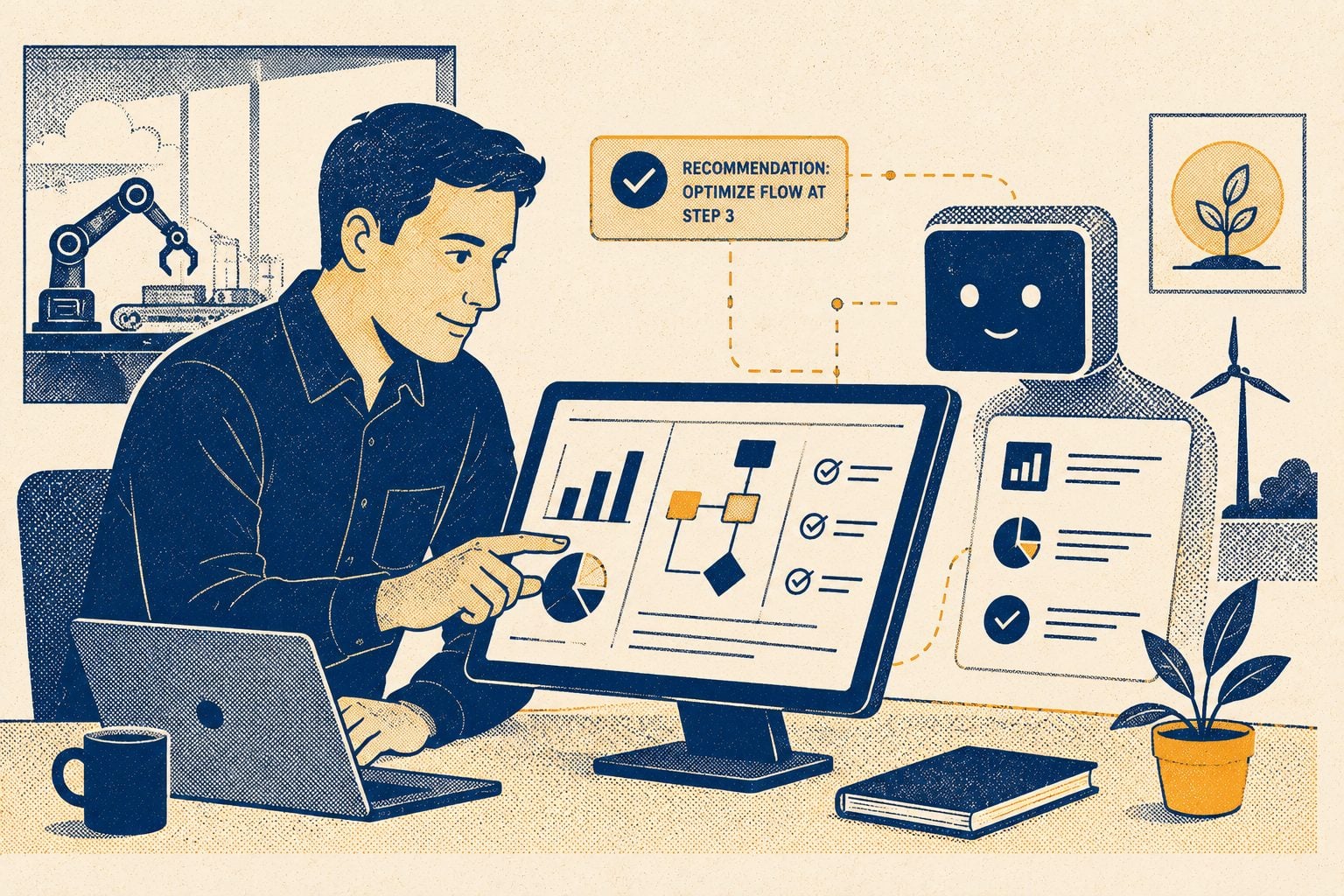
5.0 automation = the reasoning agent beside the human. An AI agent that reads an unstructured email, decides what it means, drafts a response, and hands a recommendation to a person who approves, edits, or overrides. It doesn't just execute a process — it participates in a decision the human still owns.
That is the real 4.0 → 5.0 transition for the software world: from RPA that replaces keystrokes to agentic AI that augments judgement.
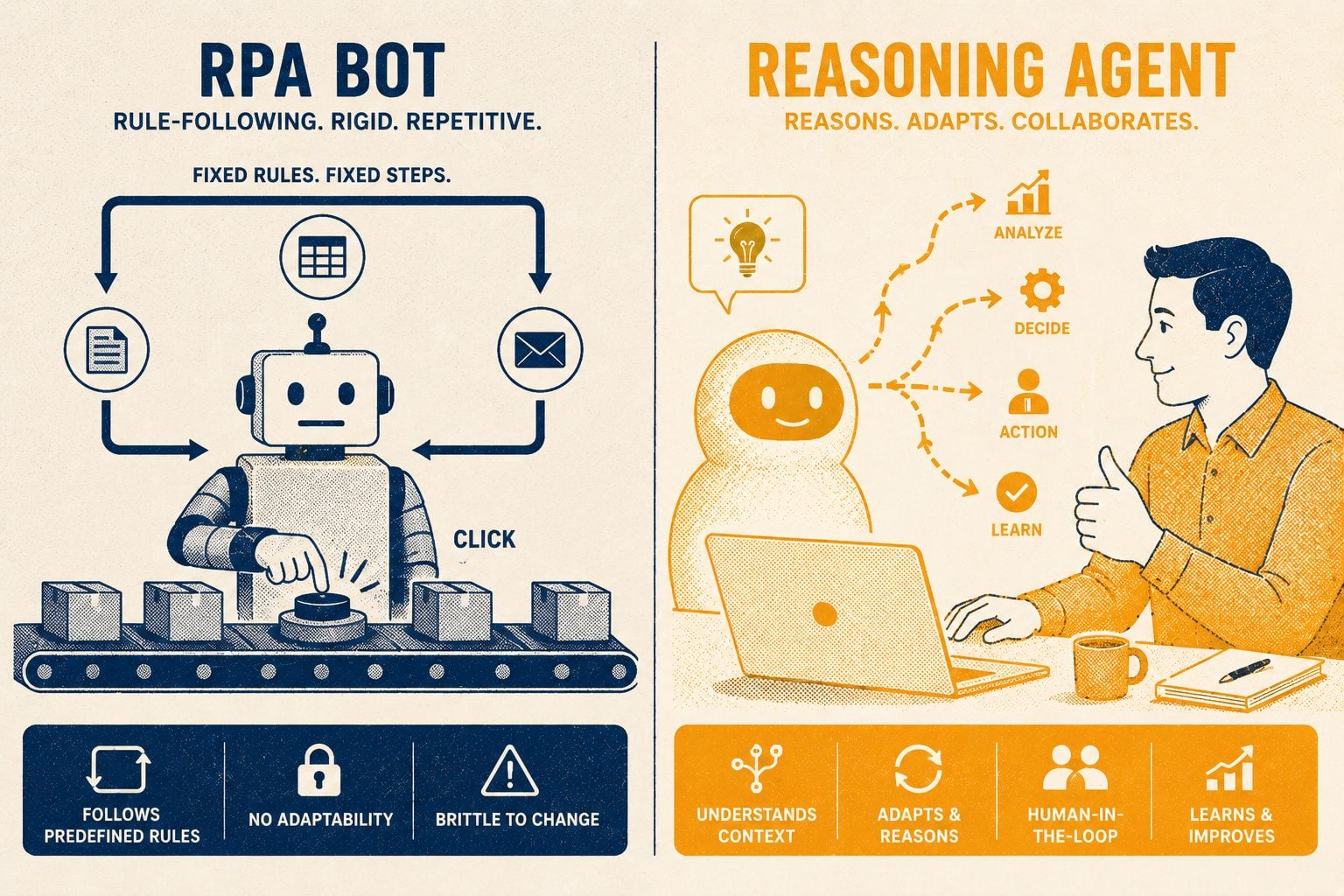
This is the most consequential idea in the whole framework. The 4.0 instinct asks "where can a bot replace a person's clicks?" The 5.0 instinct — and the regulated, defensible one — asks "where can an agent make a person faster, safer, and more confident in a decision they remain accountable for?"
That's not a soft distinction; it changes how you build the software. Agentic, human-in-the-loop systems need explainability (why did the agent recommend this?), audit trails (who approved what, when), confidence signalling (how sure is the model?), and override controls — none of which a fire-and-forget RPA bot ever needed. Build the 4.0 way and you'll re-architect for governance later. Build the 5.0 way and accountability is structural.
And What About Industry 6.0?
Here's where it gets speculative — and worth watching. 6.0 is still mostly academic (researchers admit its "futuristic nature" and "limited empirical base"), but the direction is consistent across papers.
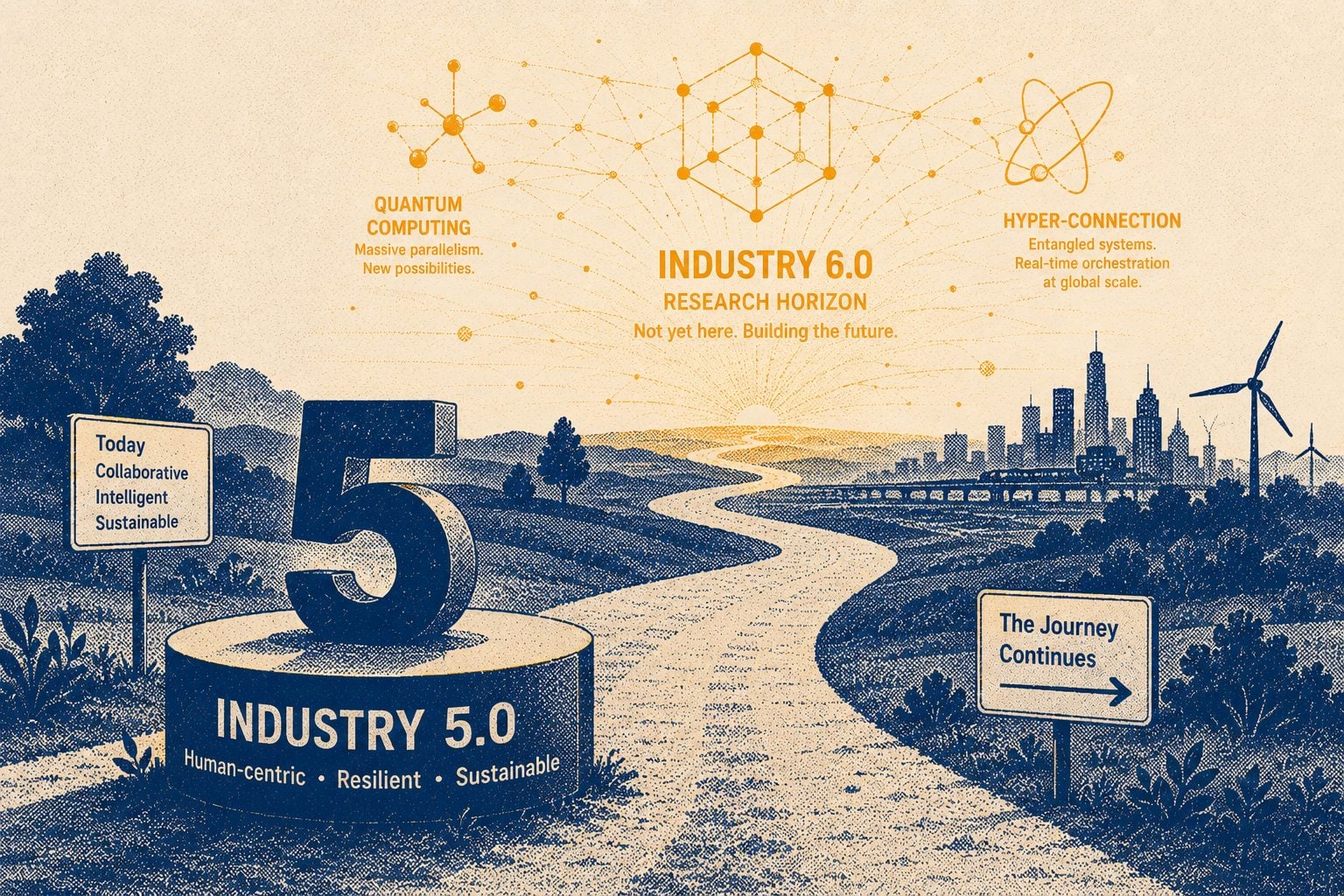
If 5.0 reintroduces the human, 6.0 is described as hyper-connected, hyper-personalised, and quantum-powered.
What 6.0 is said to add | In plain terms |
|---|---|
Quantum computing + AI | Solving optimisation problems beyond classical computers |
Ubiquitous, virtualised production | "Hyper-customer-driven" — mass personalisation as default |
Human + machine digital twins | Virtual twins of people, not just machines |
Emotionally intelligent ecosystems | Systems that sense and adapt to human state |
Humans, machines & environment in harmony | Sustainability and ethics baked in, not bolted on |
(Sources: ScienceDirect — Industry 6.0 Vision, Springer — Intelligent Automation, IJSAT)
The honest read: 6.0 is a research horizon, not a roadmap. In software terms, you can already see the early shape of it — agents that orchestrate other agents, software that reconfigures its own workflows, systems personalised per user in real time. For a Malaysian enterprise still wiring up its first bots, the lesson isn't to chase quantum. It's to build clean, modular, governable automation now — because the through-line from 4.0 to 5.0 to 6.0 is the same: less brittle scripting, more accountable intelligence, the human kept in the loop. Get those foundations right and you're not chasing the next number — you're already pointed at it.
Why This Matters Even If You're Still at 4.0
If we're at 18% adoption, isn't 5.0 (let alone 6.0) a distraction? No — and here's the practical reason.
The expensive mistake is to build your 4.0 systems as if humans don't matter, then discover in three years that regulators, customers, and your best employees all expect human-centric, explainable, accountable systems. Retrofitting that is costly. Designing for it from the first pilot is nearly free.
Industry 5.0 isn't a sequel you queue up after 4.0 finishes. It's a design principle you apply to the very next system you build. For a capital-light SME, that's the smart play: skip the dehumanised middle phase and build human-augmenting systems from the start.
The real readiness question isn't "are we ready for 5.0?" It's "are we building our current automation in a way we won't regret?"
How Symprio Helps — Across 4.0, 5.0, and Beyond
Symprio isn't a robotics integrator. We live entirely on the automation and software side — building the systems that move an enterprise from brittle, machine-first automation to accountable, human-in-the-loop intelligence. That shows up two ways:
Finishing 4.0 properly. Our automation heritage — enterprise UiPath and Power Platform across BFSI, healthcare, and public sector — is the unglamorous 4.0 work: connecting systems, killing copy-paste, making processes actually run end to end. You can't put a human in the loop of a process that doesn't have a loop yet, and you can't add an AI agent on top of automation that doesn't exist.
Building 5.0-shaped software. This is the shift from bots that follow rules to agents that support decisions. We build agentic AI and decision-support with the human deliberately in the loop — explainability, audit logging, override controls, and confidence signalling built in at the architecture stage, not retrofitted for an auditor later. This is the difference between a pilot that ships in regulated BFSI and one that stalls in risk review.
The connective tissue is our co-build model: we build the first version to production alongside your team, transfer the architecture, and leave capability behind.
What this looks like in 90 days
Claims intake copilot (insurer) — AI reads and pre-fills motor claims; a human adjuster reviews, corrects, approves. Every decision logged. 5.0 framing on a 4.0 process.
Credit pre-screen assistant (lender) — AI surfaces risk signals and a recommendation with reasons; the officer stays accountable and can override with recorded rationale.
Operations decision-support (manufacturer) — a digital-twin model lets a plant manager test "what if" before committing, rather than letting the line auto-optimise blindly.
None require finishing 4.0 first. All embed the 5.0 principle from day one.
Engaging with Symprio
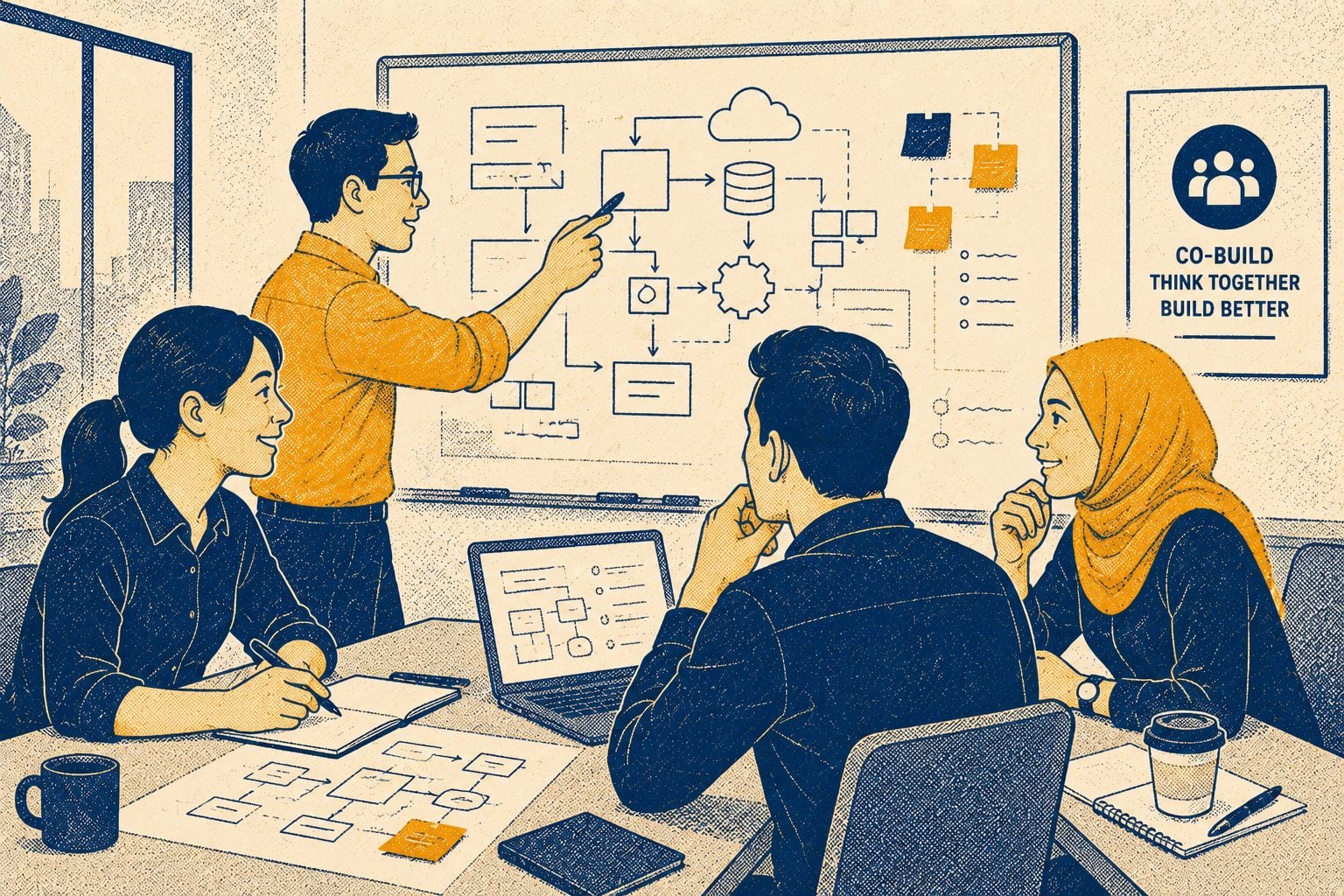
Discovery workshop (half-day, complimentary). A working session to find your highest-leverage AI-enabled opportunity — and whether your current automation is being built in a way you'll regret.
Pilot engagement (8–12 weeks). Co-build the first human-in-the-loop solution to production, with architecture transfer.
Long-term partnership. Embedded capacity to ship a product portfolio over 12–24 months.
Book a 30-minute discovery call → — no slide deck, just whiteboard thinking. · Share a brief; get an architecture sketch within 48 hours →
👉 Read related: Every AI Model Carries a Passport → · Explore our Enterprise AI services →
Sources & Further Reading
European Commission — Industry 5.0: Towards a sustainable, human-centric and resilient European industry
European Commission — Industry 5.0 Award & three pillars
ScienceDirect — IR4.0 readiness model for SMEs: A cross-sector analysis in Malaysia
ScienceDirect — Industry 6.0: Vision, technical landscape, and opportunities
Springer — Industry 6.0 and the Rise of Intelligent Automation in Manufacturing
IJSAT — Industry 6.0: Highly intelligent, human-centred, interconnected systems
MIDA — Launch of the New Industrial Master Plan 2030 (NIMP 2030)
Selangor Techsphere Summit — NIMP 2030: Malaysia's Moonshot Industrial Transformation
BizTech Magazine — Industry 4.0 vs 5.0: Complete Guide to Human-Centric Manufacturing
NeuroNomixer — Industry 5.0 Explained: Why the Future Is Human-Centred
Innovapptive — Differences between Industry 4.0 and Industry 5.0
#Symprio #EnterpriseAI #Industry50 #Industry60 #DigitalTransformation #ResponsibleAI #Malaysia #FutureOfWork
Symprio builds AI-enabled products for regulated enterprises across Malaysia, Singapore, India, and the USA — designing systems that put humans, and accountability, in the loop from the first line of code.