Every AI model carries a passport. The frontier has split into four blocs, each strong on a different axis — and picking one is the new vendor lock-in.
You set out to build your company's AI. Someone hands you a map and tells you to pick a country to settle in.
What no one tells you is that every model you could choose comes with an invisible passport — a nationality, a government behind it, an industrial strategy it serves, and a set of border rules that come along for free. In 2024 that barely mattered; the only real choice was which American lab to call. In 2026 it matters enormously, because the map has split into four kingdoms, and each one was built to win a different prize: raw capability, low cost, tight security, or strong governance. No kingdom wins all four. That single fact will shape every AI decision you make this year.

Let's take the journey, kingdom by kingdom. Watch the four scorecards — performance, cost, security, governance — because by the end you'll see why no traveller should ever settle in just one.
The Capital of Capability 🇺🇸

The first kingdom is the brightest. Anthropic, OpenAI, Google — the towers here are the tallest on the map, and the frontier of what's possible is drawn inside this skyline. On the scorecard, the Capital takes performance outright. If you need the hardest reasoning, the most capable agents, the deepest research, you come here.
But read the laws before you settle. The kingdom's government has declared a doctrine of dominance: America's AI Action Plan sets out more than ninety federal actions to accelerate innovation, build infrastructure, and lead the world — and the strategy abroad is to export the entire American AI stack as a package while pressing allies to fall in line with its export controls. The towers are magnificent. But there are toll gates at every exit, and the guards check whose papers you carry — so on governance the Capital is only middling, its own rules fragmented and shifting. And it is the most expensive land on the map: frontier flagship models run on the order of fifteen dollars per million tokens in, seventy-five out. On cost, the Capital comes last.
The Open Bazaar 🇨🇳
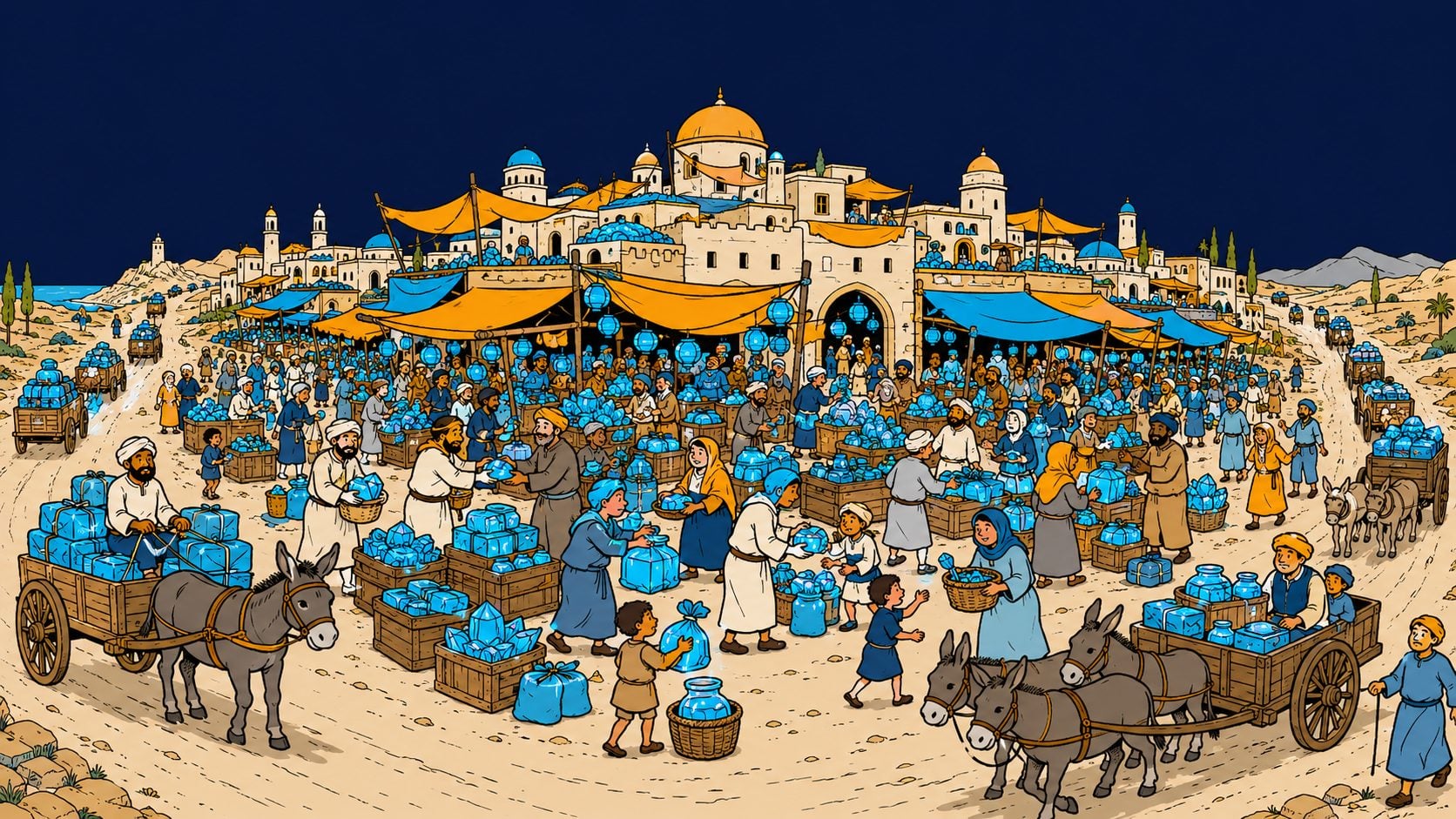
Cross the next border and the mood changes completely. This kingdom gives its goods away. DeepSeek, Qwen, Kimi — powerful models, handed out as open weights for anyone to take, modify, and run. Where the Capital sells access, the Bazaar floods the world with supply. On cost, nothing beats it — and its performance now sits a hair behind the frontier.
This too is government strategy, not accident. China's AI+ Initiative put open models at its centre, and its premier told the World Economic Forum that the country's innovation is "open and open-source." The economics behind the stalls are deliberate: drive the price of intelligence toward zero, and monetise the ecosystem, not the model. Qwen has overtaken Llama to become the most-used open-model family on earth, and roughly forty percent of new models are now built on it. The goods are real, capable, and nearly free. The catch sits on the other two axes — for a regulated Western enterprise, security and governance raise hard questions about where data goes and whose rules apply once you've built your business on stalls owned by a distant state.
The Workshop of a Thousand Tongues 🇮🇳
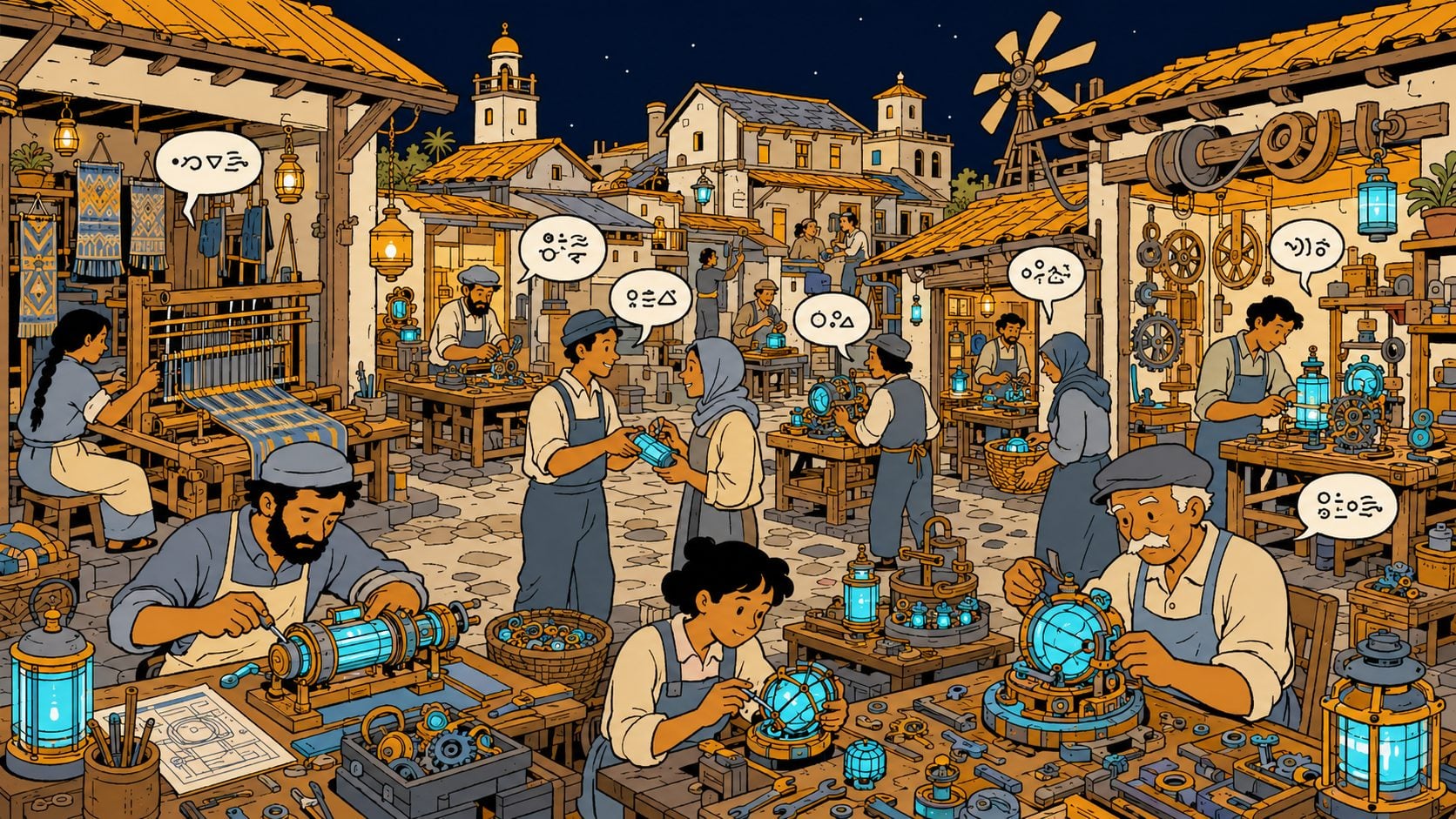
The third kingdom doesn't try to out-tower the Capital or out-give the Bazaar. It does something cleverer. In the Workshop, brilliance is frugal and it speaks every language in the room.
This is India, and its standard-bearer is Sarvam — built on compute provided under the government's IndiaAI Mission, unveiled at the New Delhi summit that India hosted in February 2026 as the first Global South nation to lead the global AI summit series. Sarvam isn't one model; it's a full Indic stack. Saaras for speech-to-text across twenty-three languages. Bulbul for natural-sounding text-to-speech. Sarvam-105B for reasoning. Sarvam Vision for documents in Indian scripts. All of it tuned for the way people in this kingdom actually speak — code-mixed, multilingual, voice-first. On security it scores well: the data stays sovereign, on home soil. On performance it sits in the middle — not built to top the frontier, built to win its own languages outright.
And then there is the price, which is the part that stops you in your tracks.
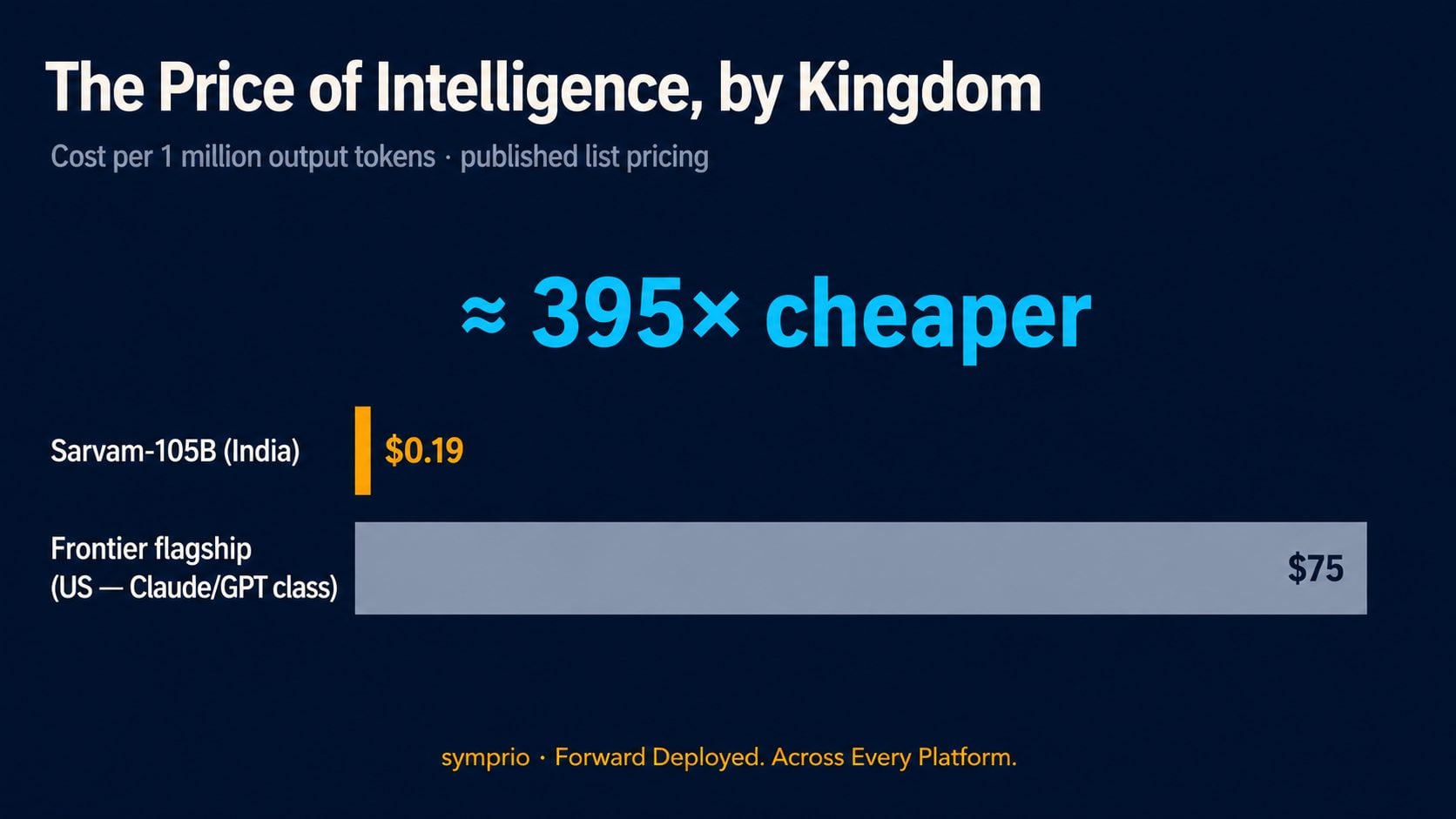
Sarvam's flagship runs at roughly four rupees per million input tokens and sixteen on output — on the order of a hundred to several hundred times cheaper than the frontier flagships of the Capital, before you even count the twenty-two Indian languages the towers can't match. Speech transcription costs about thirty rupees an hour; document digitisation, half a rupee a page. On cost, the Workshop ties the Bazaar at the top of the map. For a population-scale voice or document workload, that isn't a discount. It's the difference between an idea that ships and one that never leaves the slide deck. The Workshop proves the rule of this whole journey: for the right job, a specialised model from a smaller kingdom beats a frontier generalist outright.
The Sovereign Fortress 🇪🇺

The last kingdom is the most orderly. Mistral, Aleph Alpha — capable models, but the architecture you really come here for is trust. Everything inside the walls is built to be governed, audited, and explained. On governance and security, the Fortress tops the map.
The government here has chosen sovereignty as its banner. The EU paved the legal road for AI Gigafactories in January 2026 and gathered twenty billion euros through its InvestAI facility to build sovereign compute, because the kingdom controls less than five percent of the world's AI compute and refuses to stay dependent. And from the second of August 2026, a new law takes effect at the gates: anyone interacting with an AI system or AI-generated content must be told. The Fortress is the safest place to keep regulated data. The trade shows on the other axes — it spends more time writing rules than racing towers, so on performance it sits a step behind the Capital, and on cost it lands in the middle.
The traveller's mistake
By now you've crossed all four borders, and you're tempted to do the natural thing: pick one kingdom and settle. Build your AI as a citizen of a single land.
Lay the four scorecards side by side and you'll see exactly why that fails.
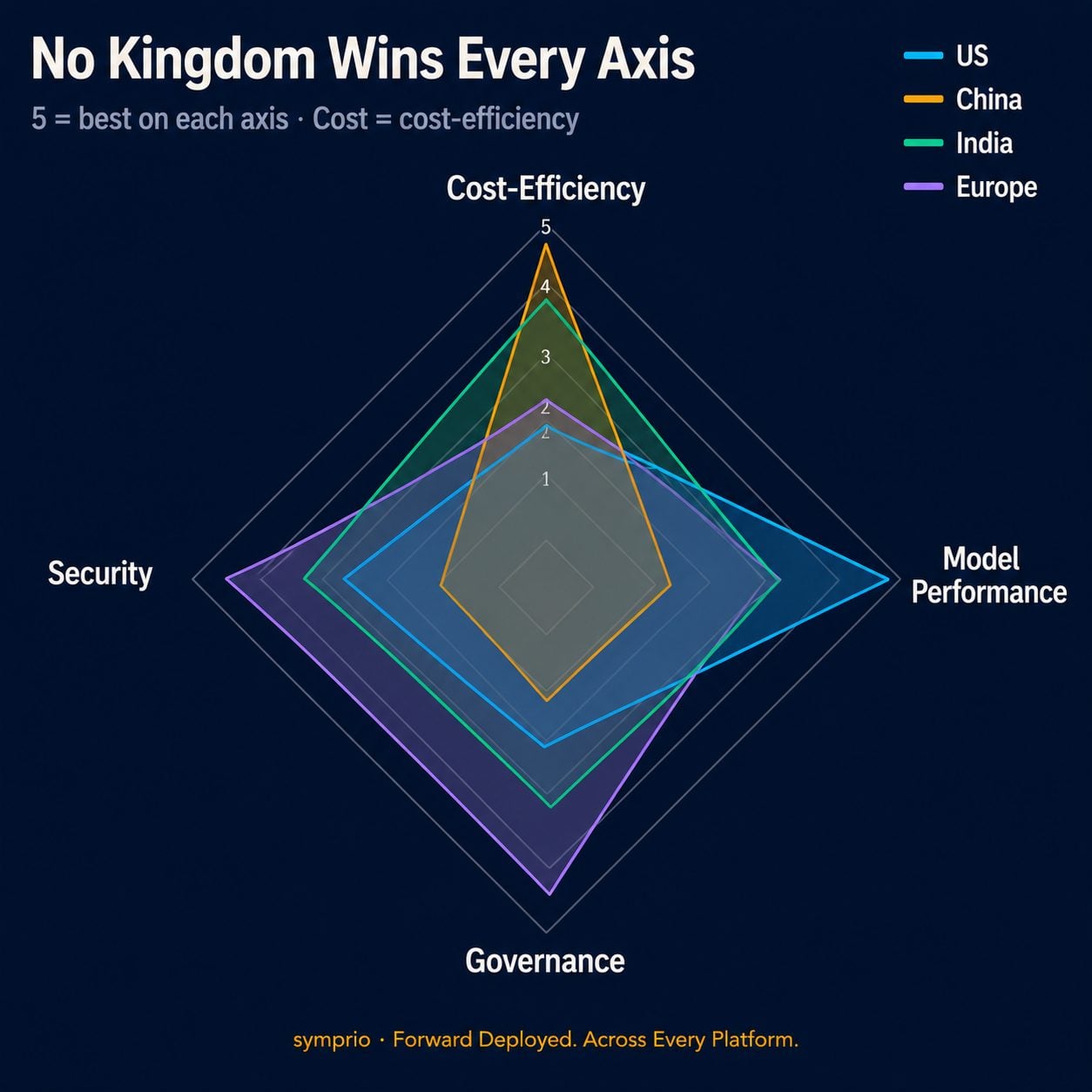
Each kingdom forms a completely different shape. The Capital reaches out on performance and collapses on cost. The Bazaar and the Workshop spike on cost-efficiency. The Fortress dominates governance and security. There is no shape that fills the whole diamond — because each was drawn by a government optimising for a different prize.
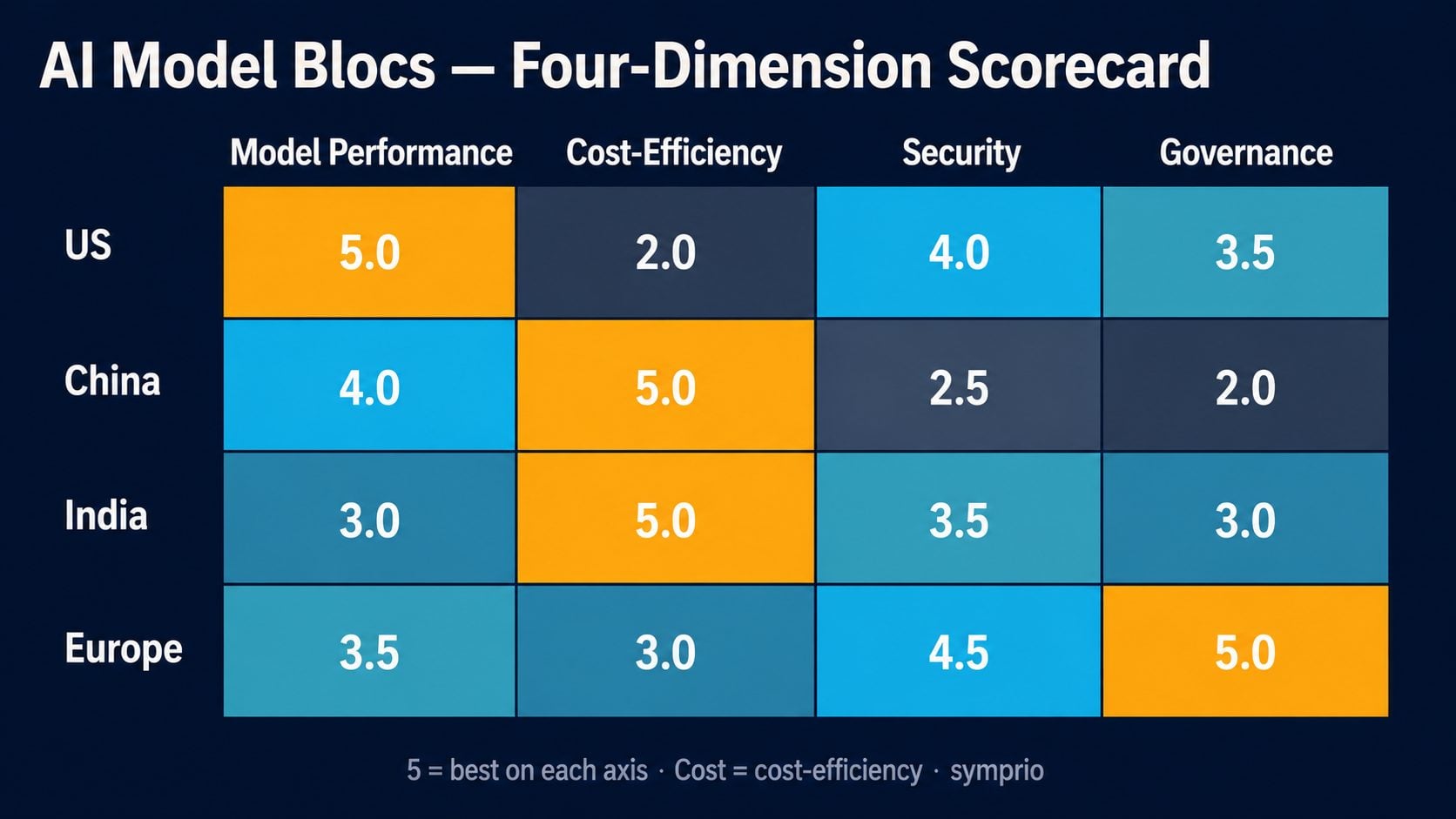
Read it as a scorecard and the trap is obvious. Choosing one kingdom means topping one or two columns and losing the rest on purpose — and inheriting, quietly, the politics, the pricing, and the border rules of whichever flag you settled under. The most capable model is the most expensive and the most politically entangled. The cheapest is the hardest to govern. The best-governed is a step off the frontier. That is the new vendor lock-in. It just wears a national costume now.
The two clever city-states

The smartest travellers on this map never tried to settle anywhere. Watch two small states who moved while everyone else debated.
The UAE made the boldest bet of all — and notice that it isn't a bet on a model. In April 2026 it unveiled the world's first agentic-AI government framework, a plan to run half of all government sectors and services on autonomous AI systems by 2028. Its leader put it plainly: AI is no longer a tool; it becomes an executive partner that analyses, decides, and executes in real time. The models are a commodity input. The thing being built is the deployment.

Singapore moved in the opposite, equally shrewd direction. In January 2026 it published the world's first governance framework for agentic AI — updated again just this May — and deliberately positioned itself not inside any kingdom but as the customs house between them, harmonising standards and bridging the rival governance philosophies. One state bet on deployment, the other on governed interoperability. Neither asked which kingdom wins. Both moved past that question to the layer that actually decides outcomes.
The Navigator

Here is what the journey was always going to teach you. You were never meant to become a citizen of one kingdom. You were meant to move freely across all four, carrying the right papers for each, choosing the kingdom that fits the task in front of you.
A real bank in Kuala Lumpur or Dubai runs a Capital model for its hardest reasoning, a Bazaar model for high-volume work where cost rules, the Workshop's Sarvam for Tamil and Hindi voice and document intelligence, and a Fortress model for data that must never leave a regulated border — all in one architecture, under its own sovereignty rules. The scorecard stops being a problem to solve and becomes a menu to assemble from. The question is never "which kingdom wins." It's which problem you're solving, and which combination of kingdoms ships it fastest, safest, and cheapest.
That requires a navigator who holds every passport and is loyal to none of the flags. Who reads the laws of all four lands, knows which gate to use for which cargo, and is paid by you, not by any kingdom's treasury. We call that navigator OmniFDE — Omni-Platform Forward Deployed Engineering. Embedded engineers who build your AI across every bloc, sell you outcomes instead of licenses, and carry no allegiance that bends the route.
Where the journey ends

The model map will keep fragmenting. More kingdoms will rise; the borders will keep moving; the scorecard will be redrawn every quarter. The enterprises that win the next few years won't be the ones who bet on the right kingdom. They'll be the ones who refused to bet on any single one — who built the freedom to move.
Every AI model carries a passport. The mistake is thinking you have to choose a nationality. You don't. You need a navigator who carries them all.
That's exactly what an OmniFDE discovery workshop is built to map.
Half a day with your team. We chart your AI estate across every bloc, score the platforms on the axes that matter to you — performance, cost, security, governance — find the one workflow worth solving first, and show you which combination ships it under your sovereignty rules.
No slide deck. Just whiteboard thinking.
→ Book your OmniFDE discovery workshop Half-day. Complimentary. Whiteboard-only.
Sources & References
🇺🇸 The US bloc — capability and export strategy
America's AI Action Plan (90+ federal actions; "dominance" doctrine): ExecutiveGov — White House AI Plan policy update; Wiley — White House Launches AI Action Plan and Executive Orders
Full-stack AI export packages & Foreign Direct Product Rule: Baker McKenzie — What the AI Action Plan and EO Mean for Export Controls
Frontier model list pricing (~$15 in / ~$75 out per 1M tokens): Anthropic Pricing; OpenAI API Pricing
🇨🇳 The China bloc — open-weight ubiquity
Chinese open models ≈30% of global usage (from 1.2% in late 2024); OpenRouter 100T-token study: South China Morning Post; TechStory
Qwen overtakes Llama on Hugging Face; surpasses US models in downloads: MIT Technology Review — What's next for Chinese open-source AI
Qwen the most-used open model; ~40% of new models built on Qwen: TipRanks — Alibaba doubles down on AI
AI+ Initiative, "open and open-source" positioning: Kai Waehner — Enterprise Agentic AI Landscape 2026
🇮🇳 The India bloc — Sarvam
Sarvam model lineup (Saaras, Bulbul, Sarvam-30B/105B, Vision; 23-language support): Sarvam AI — Models documentation
Sarvam pricing (₹4 / ₹16 per 1M tokens; speech ₹30/hour; OCR ₹0.5/page): Sarvam AI — Pricing
Sarvam-105B competitive with frontier, cheaper than Gemini Flash; IndiaAI Mission compute: TechCrunch — Sarvam's bet on open-source AI
India AI Impact Summit 2026 (first Global South host): India AI Impact Summit 2026 — overview
🇪🇺 The Europe bloc — sovereignty and regulation
AI Gigafactories legislative act (Jan 2026): Council of the EU — Council paves the way for AI gigafactories
€20B InvestAI facility; AI Act transparency from 2 Aug 2026: European Commission — European approach to AI
Europe controls <5% of global AI compute: Tech Plus Trends — EU Sovereign AI Infrastructure Stack 2026
🇦🇪 The UAE — agentic government
World's first agentic-AI government framework; 50% of government by 2028: UAE Government Media Office; Computer Weekly
UAE Sovereign AI Platform (May 2026): TechAfrica News
🇸🇬 Singapore — agentic governance
World's first agentic-AI governance framework (22 Jan 2026, WEF): Baker McKenzie; IMDA press release
Updated framework (20 May 2026): IMDA factsheet
Horizontal-sectoral model; neutral "bridge" posture: Regulations.ai — Singapore overview; Lexology — Singapore's Agentic AI Framework
Scorecard scores (performance, cost-efficiency, security, governance) are Symprio's qualitative, directional assessments for enterprise buyers — not formal benchmarks. All figures reflect publicly reported data and published list pricing as of May 2026; pricing and capabilities change frequently, so verify against the primary sources above before quoting.
Symprio is an enterprise AI delivery practice headquartered in Kuala Lumpur, building production AI across every major platform — US, Chinese, Indian, and European — without selling licenses or carrying vendor quotas. We hold every passport. We're loyal to your problem.
Forward Deployed. Across Every Platform.
#OmniFDE #EnterpriseAI #SovereignAI #SarvamAI #AIStrategy #AIVendorLockin #AgenticAI #Symprio #USvsChinaAI #AIGovernance #FDE