The audio edition couldn't be loaded right now — the written post below has everything.
AI made building cheap. Selling AI products didn't get easier. Why good AI-enabled products stall before the deal — and what sellable ones do differently
🧨 Building Got 10× Easier. Selling Didn't Move an Inch.
We've had the same conversation about a dozen times this year.
A founder opens a laptop. The product is genuinely good. It solves a real, specific, expensive problem — claims triage, reconciliation, compliance reporting, candidate screening. The demo works. The architecture is sane.
Then we ask the only question that matters: who's paying for it?
And the room goes quiet.
This is the defining problem of 2026 for anyone selling AI products: AI collapsed the cost of building software, and it did not create a single new buyer. Build capacity went vertical. Buying capacity did not move.
The receipts are ugly:
95% of enterprise GenAI pilots deliver no measurable P&L impact (Source: MIT NANDA, via Forbes)
A quarter of Y Combinator's W25 cohort shipped codebases that were 95% AI-generated (Source: TechCrunch)
Gartner expects over 40% of agentic AI projects to be cancelled by end-2027 — citing escalating costs, unclear business value, and inadequate risk controls (Source: Gartner)
Read those three together. Supply is exploding. Conversion is collapsing. The gap between them is where good companies quietly die.
Your product isn't failing because it's bad. It's failing because it was engineered to be built, not to be bought.
🌊 The Product Flood Is Real — and Mostly Fake
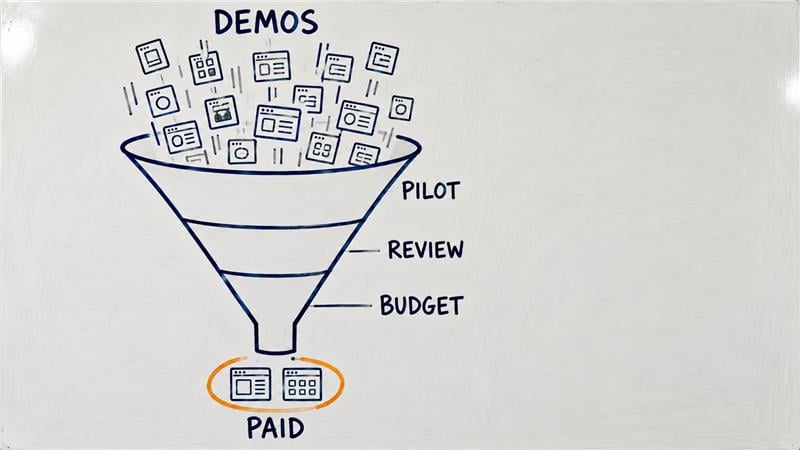
Walk any tech event in KL, Singapore or San Jose right now and you'll meet forty founders with an AI product. Twenty years ago, building that product took a team of eight and eighteen months. Today it takes two people and a weekend.
That's a genuine miracle of engineering economics. It's also a positioning disaster, because your buyer is drowning in the same flood you are.
Here's the part nobody says out loud: most of the flood isn't real. Gartner has a name for it — "agent washing", the rebranding of existing AI assistants, RPA and chatbots without substantial agentic capability — and estimates that only about 130 of the thousands of agentic AI vendors are the real thing (Source: Gartner).
Gartner's Anushree Verma puts the buyer's problem plainly: most agentic projects today are "early stage experiments or proof of concepts that are mostly driven by hype and are often misapplied."
You'd think the fakes are good news for founders doing real work. They aren't — not directly. Because from the outside, the buyer can't tell you apart from the noise. They've been burned by three "agents" that turned out to be if-statements. Their default answer is now no.
The flood didn't just add competition. It raised the burden of proof on everyone.
🕵️ So Who Is Actually Buying?
Someone is — and the direction of travel is emphatic.
Enterprises spent US$37 billion on generative AI in 2025, up from US$11.5 billion in 2024: a 3.2× year-over-year increase. And 76% of AI use cases are now purchased rather than built internally — a hard reversal from 2024, when the split was 47% built and 53% bought (Source: Menlo Ventures).
Gartner expects the pull to keep strengthening: 33% of enterprise software applications will include agentic AI by 2028, up from less than 1% in 2024 (Source: Gartner).
So the money is real, the buyers have explicitly decided they'd rather buy than build, and demand is compounding. On paper, the best market conditions in a decade.
The catch is how they buy — and how badly the last round of buying went.
Gartner survey data published in August 2026 puts numbers on the hangover: 55% of chief supply chain officers are unclear on the ROI of their AI investments, even though 67% of their digital investment now flows to AI (Source: Gartner). Two-thirds of the budget, and most leaders can't tell you what it bought.
Sit with that from the buyer's side of the table. They aren't sceptical of your product. They're sceptical of their own ability to prove your product worked — because they've just spent a year failing to prove it about everything else.
So budgets consolidate around a small number of vendors who already cleared the trust bar — the ones who survived last year's security review and now get the benefit of the doubt on this year's use case.
Translation for the boardroom: enterprises aren't buying AI products. They're buying vendors they can defend.
That's the bar. Now let's look at why good products keep missing it.
🚧 Five Reasons a Genuinely Good AI Product Doesn't Sell
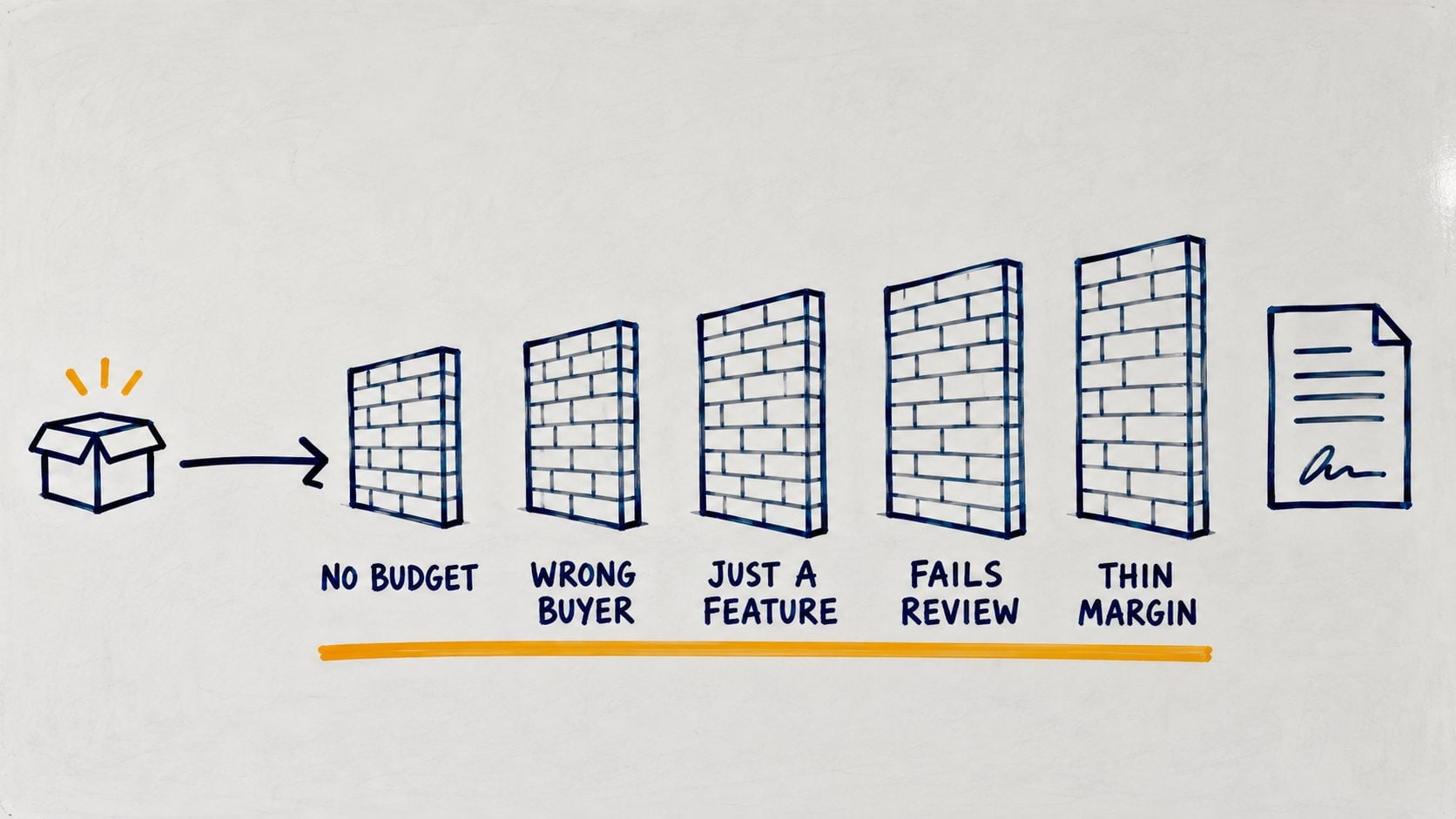
1. You solved a real problem — just not a budgeted one. Pain is not the same as a budget line. If no cost centre currently owns that pain, there is no number on a P&L for your product to move, and nothing for a CFO to reallocate. "This saves 20 hours a week" only converts when someone can name whose 20 hours — and what happens to them afterwards.
2. Your user loves it. Your buyer has never met you. The person who feels the pain (ops manager), the person who signs (CFO or head of division), and the person who can kill it (IT security, risk, procurement) are three different people with three different fears. Founders demo to the first and get ambushed by the third. And you can't automate your way past this: Gartner projects that by 2028 AI agents will outnumber sellers 10 to 1, yet fewer than 40% of sellers will say those agents improved productivity (Source: Gartner). More outbound is not the fix. As Gartner's Dan Gottlieb puts it, if the underlying systems are fragmented, the agents will scale the fragmentation.
3. It's a feature — and the model vendor ships features for free. If your product is a prompt, a UI and an API key, your roadmap belongs to somebody else. Every frontier release quietly deletes a category of thin wrappers. Depth is the only defence: workflow ownership, proprietary data, integrations that took real work. (We drew that line precisely in Deep AI vs Applied AI →.)
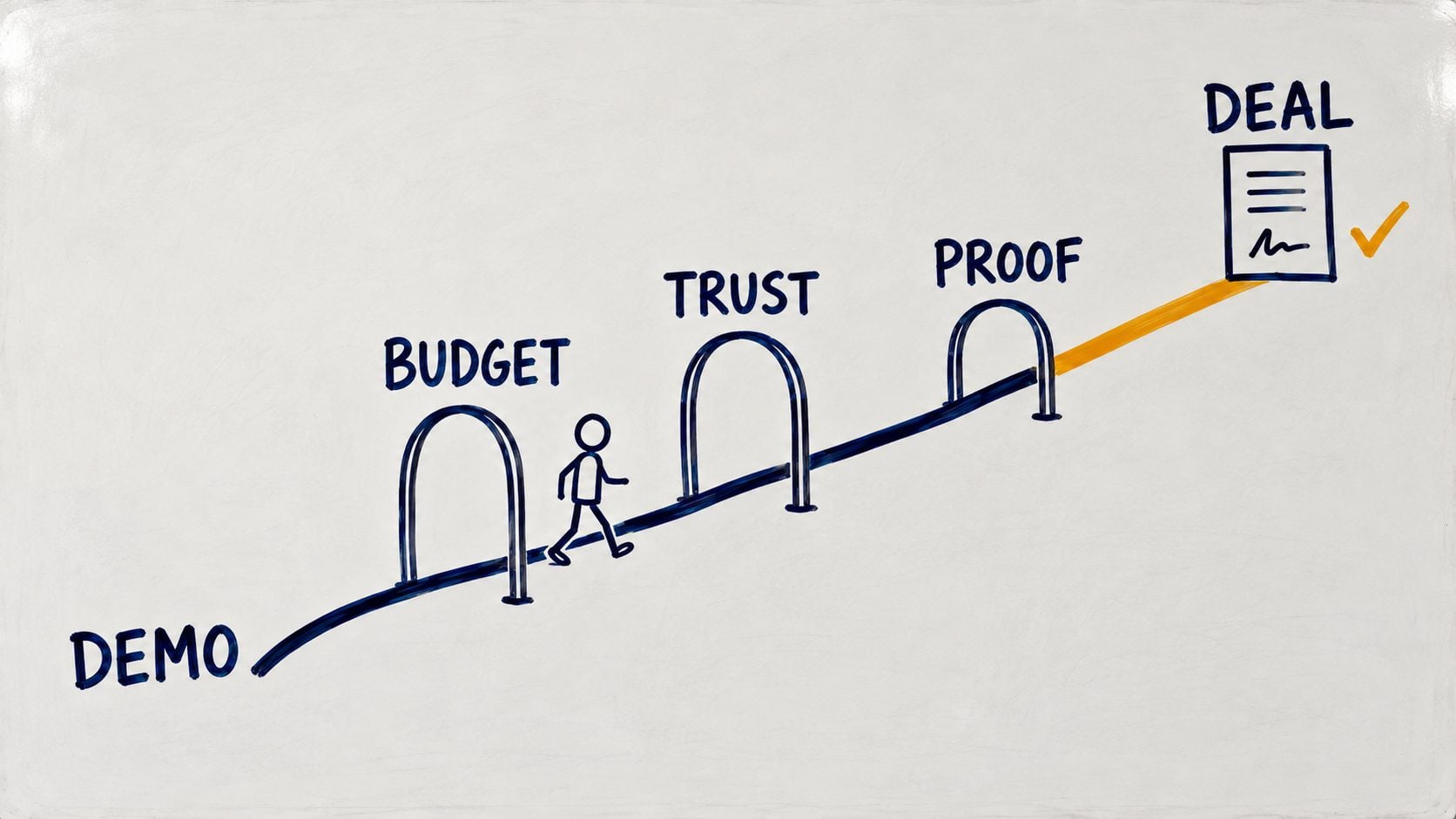
4. You can't survive the trust gate. In regulated sectors the deal isn't won in the demo, it's won in the 200-line security questionnaire. Data residency. Privacy obligations under PDPA or GDPR. Third-party risk assessment — for Malaysian banks, against BNM's RMiT expectations. Model governance. Audit trail. Exit plan. A four-person startup treating this as paperwork for "after the LOI" will spend nine months losing. This is exactly why certifications like SOC 2 and ISO 27001 stop being a compliance chore and start being a sales asset.
5. You priced like SaaS but you cost like infrastructure. Traditional software has near-zero marginal cost. AI products don't — inference is COGS. a16z spotted the structural consequence early and it has aged well: AI companies show "gross margins often in the 50-60% range – well below the 60-80%+ benchmark for comparable SaaS businesses," driven by heavy cloud infrastructure usage and ongoing human support (Source: a16z). Sell flat-rate unlimited seats to a heavy user and you've sold yourself a liability.
None of these are product-quality problems. Every one is a product engineering and positioning problem — which is good news, because those are fixable.
📊 What Your Deck Shows vs What They're Actually Approving
Your pitch deck | The buyer's approval memo |
|---|---|
A demo that wows in four minutes | A named cost line this replaces or defers |
"10× faster" | A baseline, a measurement method, and an internal owner |
Model quality and benchmark scores | Data residency, audit trail, privacy and AI-governance posture |
Feature roadmap | Whether your company survives third-party risk review |
Usage-based pricing | A predictable annual number that fits this budget cycle |
Logo slide of global brands | One reference customer in their industry, in their country |
(Framing informed by Menlo Ventures and Gartner)
The left column is where founders spend 90% of their engineering budget. The right column is what actually closes.
The Malaysian Reality Check
Malaysia is the sharpest illustration of the gap right now — and it's a market we deliver into every week.
On 28 July 2026, the government launched AI Malaysia Berhad (AIMB) as the national AI lead agency under the Ministry of Digital, formally institutionalising the National AI Office, and unveiled the National AI Action Plan 2026–2030 alongside it (Sources: Skrine; AI Malaysia). Capital backs the ambition: MDEC secured RM87.4 billion in approved digital investments in 2025, driven largely by AI, big data, data centres and cloud (Source: The Edge Malaysia).
Now read the Action Plan's stated aspiration closely. Malaysia intends to become a regional digital technology hub and a producer of "globally competitive Made by Malaysia AI products and services by 2030."
Products. Not pilots, not papers, not data centres. Products — which by definition means products that someone, somewhere, chooses to buy.
That single word turns this whole post into a national-strategy problem. Malaysia is not short of engineering talent, and after 2026 it is certainly not short of policy scaffolding. What the AI Nation ambition actually rests on is whether Malaysian-built AI products can win commercial deals against global competitors. Building them was never the bottleneck. Selling them is.
And yet local founders keep stalling for three structural reasons:
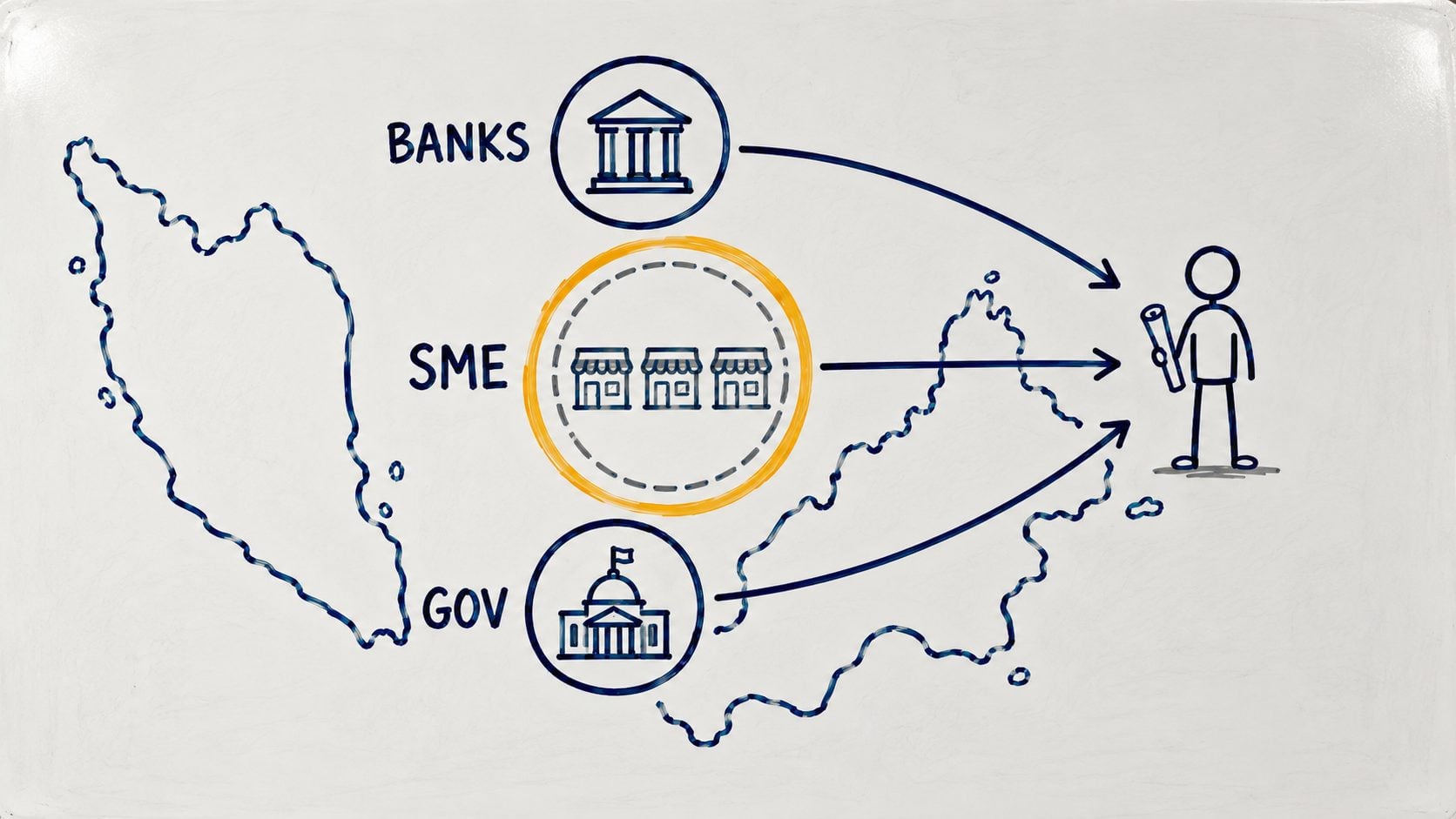
The enterprise buyer pool is small and slow. Malaysia has a finite number of banks, insurers, telcos and GLCs, each running a long, committee-driven procurement cycle. You can't brute-force volume — every logo is a named, multi-quarter campaign, and losing one on a security technicality costs you a year.
The SME pool is enormous but doesn't buy the way your model assumes. SMEs dominate Malaysia's business landscape by count, but they buy through relationships, resellers, and the accounting software they already run — not a self-serve signup page and a credit card.
Grants subsidise the build. Nothing subsidises the selling. MDEC's MDAG-AI offered up to 70% of total project cost or RM2 million, whichever is lower (Source: MDEC) — and that window has already closed, with applications ending 18 July 2025. Which makes the point sharper, not softer: funding programmes reliably de-risk construction, never distribution, and they don't wait for you. A grant-funded product with no channel is just a more expensive shelf. It's the sibling of the argument we made in Your AI Pilot Was the Cheap Part →.
There is, though, a real advantage hiding in the new institutional layer. AIMB's remit explicitly covers trusted AI governance and includes a Malaysia AI Safety Institute (MY-AISafe), with an AI Governance Bill proposed. Most founders will read that as compliance overhead arriving. Read it the other way: a national assurance standard is the cheapest trust surface a small vendor will ever get handed. When the buyer's veto is risk, an external benchmark you can align to is not a tax — it's a shortcut through the exact gate that kills most deals.
Read all of that together and one conclusion falls out: in this market, distribution is designed, not discovered.
🔁 What Sellable AI Products Do Differently
Five moves separate products that convert from products that demo beautifully and die.
Attach to a budget line before you write code. Not a persona. Not a pain point. A cost centre with an owner, a current annual spend, and a manager measured on reducing it. If you can't name it in one sentence, you don't have a product — you have a prototype with a market hypothesis attached.
Ship the measurement with the product. Bake in the baseline: cases handled per day before, after, and at what cost per case. Remember the 55% of executives who can't articulate the ROI of what they already bought — that is your real competition, and it isn't another vendor. Hand the buyer the evidence pack for their renewal conversation and you've pre-written your own business case. In a market this sceptical, measurement isn't a feature. It's the pitch.
Make trust a feature you build, not a PDF you write. Role-based access, immutable audit logs, data residency options, defensible retention policies, documented model routing, human-in-the-loop checkpoints on high-risk actions. Built in sprint one, this turns a nine-month security review into a six-week one. Retrofitted, it costs three times as much and you lose the deal anyway.
Own a workflow, not a prompt. The moat is never the model — it's integration into the system of record, the exception handling nobody wants to build, and the domain rules that took nine months of client conversations to encode. Depth is what a frontier release can't casually delete.
Borrow distribution instead of building it. The fastest route into the mid-market isn't a bigger sales team — it's the channel already sitting inside the buyer's operations: accounting software ecosystems, system integrators, industry associations, and compliance waves like LHDN MyInvois that put a deadline on the buyer's calendar for you.
The lesson is not that AI products are hard to sell. The lesson is that unpositioned AI products are impossible to sell.
💎 The Symprio Approach: Build Products That Survive Procurement
Symprio is a product studio and an enterprise services firm in one. We ship our own AI-enabled products — HireOps AI for recruiting, and an LHDN MyInvois-integrated e-invoicing platform — and we build them for clients across the US, APAC and the Middle East. What we optimise for is not demo quality. It's sellability. Four principles guide the work.
Engineer for the security review, not for demo day. Every product we build ships with the artefacts an enterprise buyer will demand: role-based access, audit logging, data minimisation, and documented model routing — deployed inside your own VPC or on-prem, so data never leaves your infrastructure and SOC 2, ISO 27001, GDPR and internal data-residency requirements are satisfied by architecture rather than by promise. Sprint one, not sprint twelve. That is also why a production agent takes us four to eight weeks including governance sign-off, not four to eight months. See how we build AI applications →
Instrument the value, or it doesn't exist. We scope every build around a single workflow with a named owner and a measured baseline, so ROI is an observable fact rather than a slide. That instrumentation is what turns a pilot into a renewal.
Integrate into the system of record. Real defensibility lives in the plumbing — SAP, Oracle, Salesforce, core banking and policy-admin systems, MyInvois. We build the integrations and exception paths that thin wrappers skip, because that's the part a frontier model release can't erase. We stay platform-agnostic across OpenAI, Anthropic, Azure OpenAI, Gemini, Bedrock and open models, and pick per workload on data residency, latency and cost — which is also how the gross-margin maths stays survivable.
Put engineers where the deal actually stalls. MIT's 95% figure is the reason we built OmniFDE →, our vendor-neutral Forward Deployed Engineering model: embedded engineers fluent across Anthropic, UiPath, Microsoft, Google, Oracle, OpenAI and open source. Pilots don't die in the model layer. They die in the last mile between a working demo and a system a buyer will sign for — so that's where we put people.
🛠️ What That Looks Like in 90 Days
Within 90 days of engagement, teams typically ship products such as:
An SME onboarding and credit pre-screen agent with a documented decision trail — sellable into banks because of the trail.
An LHDN MyInvois e-invoicing integration distributed through the accounting-software ecosystem the buyer already runs.
A motor claims intake co-pilot instrumented to report cost-per-claim from day one.
An AML / fraud investigation acceleration agent built to pass third-party risk review, not just a demo.
An internal knowledge assistant routed to right-sized models, so gross margin survives contact with a heavy user.
These aren't moonshots. They're products with a named buyer, a measured outcome, and a trust surface — which is precisely what makes them sellable.
💬 Over to You
Where is your product stuck?
A demo everyone loves and nobody has budgeted for?
A pilot that's been "nearly signed" since Q1?
A security questionnaire that's been open for four months?
A logo win that turns out to be gross-margin negative?
These are exactly the problems Symprio solves.
📞 Let's Build Something Sellable
Stop letting build-first thinking cap your commercial ambitions. It's time to build AI products engineered to be bought — designed around a budget line, a measurement, and a trust surface from the first sprint.
Reach out to the Symprio team today and let's turn your demo into a product an enterprise can actually approve.
👉 Explore our AI Application Development practice →
👉 Book a 30-minute discovery call → — no slide deck, just whiteboard thinking
👉 Read related: Your AI Pilot Was the Cheap Part →
❓ FAQ: Selling AI Products
Why are AI products so hard to sell in 2026?
AI collapsed the cost of building software without creating new buyers, so supply exploded while enterprise buying capacity stayed flat. Buyers burned by failed pilots — 95% of enterprise GenAI pilots show no P&L impact — now demand proof of budget impact, security posture, and measurable outcomes before signing anything.
Who actually buys AI-enabled products in an enterprise?
Three different people: the user who feels the pain, the executive who signs the budget, and the risk, security or procurement function that can veto the deal. Most AI products are demoed to the first and defeated by the third. Sellable products are engineered for all three.
What is agent washing?
Agent washing is Gartner's term for vendors rebranding existing AI assistants, RPA tools and chatbots as "agents" without substantial agentic capability. Gartner estimates only about 130 of the thousands of self-declared agentic AI vendors are real — which is why enterprise buyers now default to scepticism.
Is my AI product just a feature?
If it's a prompt, a user interface and an API key, yes — and the next frontier model release can delete it. Defensibility comes from workflow depth: integration into systems of record, proprietary data, encoded domain rules, and exception handling that took real engineering time.
What is Malaysia's National AI Action Plan 2026–2030?
Launched on 28 July 2026 alongside AI Malaysia Berhad — the national AI lead agency that institutionalises the former National AI Office — the plan sets national priorities for a sustainable AI ecosystem, targeting Malaysia as a regional digital technology hub and a producer of globally competitive "Made by Malaysia" AI products and services by 2030.
What makes an AI product "sellable"?
A named budget line it reduces, a measured baseline proving it works, a trust surface that survives security review, integration depth a model release can't erase, and pricing that stays gross-margin positive under heavy use. Product quality is assumed; these five are what actually close deals.
📚 Sources & Further Reading
Forbes — MIT Finds 95% of GenAI Pilots Fail Because Companies Avoid Friction
Menlo Ventures — 2025: The State of Generative AI in the Enterprise
Gartner — Over 40% of Agentic AI Projects Will Be Canceled by End of 2027
a16z — The New Business of AI (and How It's Different From Traditional Software)
The Edge Malaysia — AI Nation 2030 and Malaysia's Next Phase of Growth (sponsored feature)
MDEC — Malaysia Digital Acceleration Grant: Artificial Intelligence (MDAG-AI)
Gartner — AI Agents Will Outnumber Sellers 10 to 1 by 2028 (July 2026)
Gartner — Majority of Chief Supply Chain Officers Unclear on AI Investment Returns (August 2026)
Symprio — OmniFDE: Vendor-Neutral Forward Deployed Engineering
#Symprio #BuildNotBuy #EnterpriseAI #AIProducts #AgenticAI #SME #Malaysia
Symprio builds AI products engineered to be bought, not just built. Find us at symprio.com.