The US has suspended Claude Fable 5 and Mythos 5. Here's what happened, why it's likely temporary, and why an OmniFDE-built AI implementation barely feels it.
Quick question before you read on. On 9 June 2026, Anthropic shipped the most capable model it had ever released to the public. On 12 June 2026 — three days later — it switched that same model off for every customer on Earth. What changed in 72 hours?
Not the model. The politics around it.
If your reaction to that news was a quiet jolt of "wait, is our AI about to stop working?", this post is for you. Because the honest answer depends entirely on one thing: how your AI implementation was built. A well-architected agent stack shrugs off a single model disappearing. A brittle one that hard-wired itself to one vendor's flagship endpoint does not. The difference is design — and design is a choice you make before the crisis, not during it.
Let's walk through exactly what happened, why it happened, whether it's permanent, and why an implementation built the OmniFDE way barely registers the shock.
What Is Fable 5 — and Why Not Mythos?
Earlier this week Anthropic launched two models built on the same underlying system: Claude Fable 5 and Claude Mythos 5. Both descend from Claude Mythos Preview, an exceptionally capable model that had been restricted to a small set of research and security partners under an initiative called Project Glasswing. When Anthropic unveiled the pair this week, it said the Mythos family would remain restricted to Project Glasswing participants, while Fable would be made publicly available.
That is the crux of the Fable-versus-Mythos distinction. They are, mechanically, the same model. Mythos 5 is the raw, less-restricted version reserved for trusted cybersecurity and biology users. Fable 5 is that same engine wrapped in guardrails so it can be handed to the general public safely. When Anthropic launched the models, it shipped Fable 5 with safeguards that route sensitive queries — topics tied to cybersecurity, biology, chemistry, and distillation — to Claude Opus 4.8 instead, a fallback Anthropic said fires in less than 5% of sessions.
So why does the public get "Fable" and not "Mythos"? Because Fable is Mythos with a safety jacket on. The fable, in other words, is the cautionary tale wrapped around a powerful engine — and as it turns out, that framing became uncomfortably literal within days.
The Enhancement: What Anthropic Actually Released
This was not a routine point release. Anthropic introduced an entirely new capability tier above its Opus-class models — "Mythos-class." The company claimed at launch that the model represents a new level of capability, with capabilities that "exceed those of any model we've ever made generally available."
The headline gains were in serious knowledge work: software engineering, scientific research, vision, and long-running autonomous tasks — exactly the workloads enterprise AI agents are built on. The model was particularly effective at identifying software vulnerabilities, and experts had warned that this capability posed a risk of being used in cyberattacks.
That last sentence is the whole story in miniature. The same skill that lets Fable 5 find and fix security holes for a defender lets it find security holes for an attacker. Anthropic knew this — it red-teamed the safeguards for thousands of hours before launch. Ahead of launch the company red-teamed Fable's safeguards with the US government, the UK AI Safety Institute, third-party organisations, and internal teams, and says testers had not found a universal jailbreak. But "not found yet" and "cannot exist" are different claims, and a government deciding which one applies is a political act, not a technical one.
Why the US Government Stopped It

Here is the timeline that matters.
Anthropic said it received an order on Friday afternoon — at 5:21 p.m. Eastern Time — instructing it to suspend all access to the models. The US Commerce Department used national security export controls to bar the company from distributing Fable 5 and Mythos 5 to any foreign national. Crucially, the scope was sweeping: the directive includes not just people located outside the US, but also any foreign national inside the US, including Anthropic's own non-citizen employees.
That scope is why the whole world lost access at once. Anthropic could not surgically block only foreign nationals without crippling a huge slice of its user base — so it pulled the plug entirely. The company said it chose to shut down access completely, given that selective compliance would have required blocking a wide swath of users, among them Anthropic's own foreign-born staff. Every other Claude model — including the current default, Opus 4.8 — kept running.
The stated trigger was a security concern, not a contract dispute. An administration official told Axios the Commerce Department took action after another company claimed it was able to jailbreak Mythos, alarming the administration about possible national security risks. Anthropic's own understanding is that the government believes it became aware of a method of bypassing, or "jailbreaking," Fable 5.
The deeper read, voiced sharply by one cybersecurity researcher, is that Anthropic partly wrote its own predicate: "If you describe your product as a munition in every press release, eventually a government takes you at your word." When the most capable models are marketed as strategic assets, every safety knob becomes a lever of state power — and access stops being a product decision and becomes a sovereignty question.
Is the Ban Temporary or Permanent?
The most important word here is "misunderstanding" — and it is Anthropic's word, not ours.
Anthropic is complying with the directive while openly disputing the reasoning. The company says it disagrees that the finding of a narrow potential jailbreak should be cause for recalling a commercial model deployed to hundreds of millions of people, and warns that applying that standard across the industry would essentially halt all new model deployments for every frontier provider. Its position on the specific exploit is technical and narrow: Anthropic said it believed the jailbreak the government cited was a narrow one that would unlock Mythos's cybersecurity capabilities in only one specific instance, not a universal one that would defeat all of Fable 5's safeguards.
Most tellingly, Anthropic is signalling this is fixable, not fatal: "We believe this is a misunderstanding and are working to restore access as soon as possible."
So the honest, current read — facts are still moving — is that this looks like a temporary disruption, not a permanent ban. A narrow technical concern, a company disputing it through proper channels, and a stated intent to restore access point toward a pause rather than a tombstone. There is precedent for the courts intervening in government action against Anthropic, too. Earlier in 2026, a US federal judge temporarily blocked a separate Pentagon stop-use order against the company as it challenged that action in court.
But here is the uncomfortable truth for any business leader: "probably temporary" is not a foundation you can build a production system on. The episode proved that a frontier model can vanish in hours, by forces entirely outside your control or your vendor's. The question is no longer will this specific model come back — it's what happens to your operation the next time any model goes dark for any reason.
What This Means for Your AI Agents (Spoiler: Less Than You Fear)
Let's be specific, because this is where the panic usually lives and where it usually dies.
If your organisation built AI agents that call one provider's one flagship model by a hard-coded name, with prompts tuned to its exact quirks and no fallback path, then yes — a sudden suspension is a genuine outage. Your agents return errors. Your workflows stall. You spend a frantic week re-pointing and re-testing everything.
But that is an architecture failure, not a model failure. And it is entirely avoidable.
A well-built enterprise AI implementation treats the model as a swappable component, not a foundation stone. In practice that means:
A model-routing layer that can switch the underlying model — Opus 4.8, a Sonnet-class model, or a different provider entirely — without touching the agent logic above it.
Capability-based fallbacks so that if a "frontier" tier disappears, work degrades gracefully to the next-best model rather than failing outright.
Prompts and evals that are portable, not tuned so tightly to one model's idiosyncrasies that they break on any other.
Governance that assumes volatility — because in a world of export controls and national-security directives, model availability is now a regulatory variable, not just a technical one.
When Fable 5 went dark on Friday, the businesses that barely noticed were the ones whose architecture already assumed a model could disappear. Their router fell back to Opus 4.8, evals confirmed the outputs held, and operations continued. That is not luck. That is design.
The Symprio POV: We Build for the Model That Doesn't Exist Yet
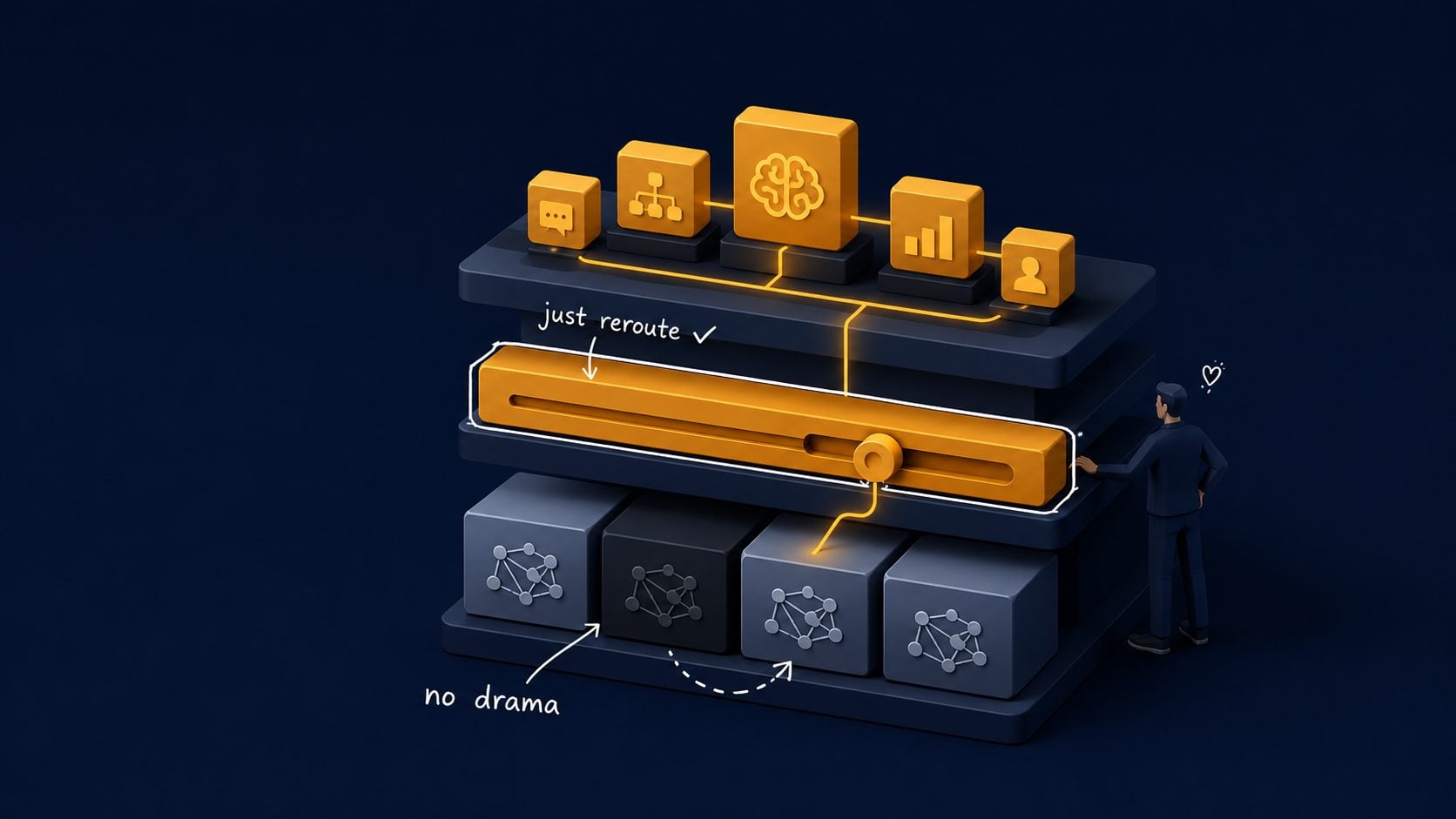
At Symprio, model volatility is not a surprise we react to — it is a design assumption we start from. This is the core of how an OmniFDE consultant (our Forward-Deployed Engineering practice) approaches an AI implementation: the model is the most replaceable part of the system, so the architecture is built to survive its replacement.
Concretely, an OmniFDE-led build gives you:
A provider-agnostic agent architecture where the reasoning engine sits behind an abstraction layer, so Anthropic, and other frontier providers are configuration choices — not load-bearing dependencies.
Sovereign-cloud and governance alignment to BNM, PDPA, AIGE, and the AICB AI Governance Framework — which already treats model availability and data residency as risks to be managed, not assumed away.
A regression eval harness so that when you switch models — by choice or by force — you can prove in hours, not weeks, that your agents still produce correct, compliant outputs.
Adopt-and-build delivery, where we co-build the first implementation with your team and transfer the architecture, so your engineers can re-point the stack themselves the next time the ground shifts.
The Fable 5 suspension is, for our clients, mostly a teaching moment rather than an emergency. It validated a principle we have argued for from day one: in enterprise AI, the durable asset is the architecture, the evals, and the governance — never the specific model behind the curtain.
What We Could Build for You in 90 Days
To make this concrete, here are implementations an OmniFDE engagement could ship — each designed model-agnostic from the first line:
An AML / fraud investigation acceleration agent for a BFSI client, with a routing layer that survived Friday's suspension untouched.
An LHDN MyInvois e-invoicing middleware with AI-assisted validation that degrades gracefully across model tiers.
An internal knowledge assistant trained on your SOPs and operations manuals, portable across providers.
A customer-service triage agent with sentiment and escalation routing, where the model is one swappable config value among many.
None of these should ever live or die by a single endpoint. That is the entire point.
Frequently Asked Questions
What is Claude Fable 5?
Claude Fable 5 is Anthropic's most capable publicly released model, launched on 9 June 2026 in a new "Mythos-class" tier above Opus. It is the same underlying engine as the restricted Mythos 5 model, but shipped with safeguards that route sensitive queries to a safer fallback model.
Why was Fable 5 suspended?
The US Commerce Department issued a national-security export-control directive on 12 June 2026 barring distribution of Fable 5 and Mythos 5 to any foreign national. Because the order covered foreign nationals worldwide, Anthropic disabled both models for all customers to ensure compliance.
Is the Fable 5 ban permanent?
Current indications point to a temporary suspension rather than a permanent ban. Anthropic has called the situation a likely misunderstanding, disputes that a narrow exploit justifies recalling a public model, and says it is working to restore access as soon as possible. Facts are still developing.
Will the suspension break my company's AI agents?
Only if your agents were hard-wired to one model. A model-agnostic architecture with a routing layer and fallbacks switches to another model — such as Opus 4.8 — without interrupting operations. The risk lives in the design, not the news headline.
How does an OmniFDE consultant prevent this kind of disruption?
An OmniFDE consultant builds the model as a swappable component behind an abstraction layer, with capability-based fallbacks, portable prompts, and a regression eval harness. This lets your team re-point the stack to a different model in hours, regardless of which provider is affected.
Working With Symprio
Symprio engages with enterprise and BFSI teams in three formats:
Discovery workshop (half-day, complimentary). A working session with your senior team to map where your current AI implementation carries hidden single-model dependency risk.
Pilot engagement (8–12 weeks). An OmniFDE consultant co-builds your first model-agnostic agent to production, including the routing layer, eval harness, and architecture transfer.
Long-term partnership. Embedded capacity to build a resilient portfolio of AI products over a 12–24 month horizon.
The next model suspension will arrive without warning, just like this one did. The only question is whether your architecture is ready for it.
👉 Request a discovery workshop → · Share a brief; receive an architecture sketch within 48 hours → 👉 Explore our enterprise AI architecture services →
Sources & Further Reading
Anthropic — Statement on the US government directive to suspend access to Fable 5 and Mythos 5. anthropic.com
Fortune — Anthropic disables Fable and Mythos AI models following U.S. government export ban. fortune.com
TIME — Anthropic Pulls Its Most Powerful AI Models After U.S. Bars Foreign Access. time.com
CNBC — Anthropic disables access to Fable 5 and Mythos 5 to comply with government directive. cnbc.com
9to5Mac — Anthropic pulls Claude Mythos 5 and Claude Fable 5 following US government directive. 9to5mac.com
Quartz — Anthropic disables Claude Fable 5 and Mythos 5 after export control directive. qz.com
allthings.how — Anthropic Disables Fable 5 and Mythos 5 After a US Export Order. allthings.how
Tech Policy Press — Anthropic's Mythos Recall and the White House's Missing AI Safety Playbook. techpolicy.press
#Symprio #EnterpriseAI #AIGovernance #AIArchitecture #BFSI #ResponsibleAI #Malaysia #BuildNotBuy
Symprio builds resilient, model-agnostic AI products for Malaysia's regulated enterprises — engineered to survive the next disruption, not just the last one.