95% of enterprise AI pilots fail. Rolling out ChatGPT to your org is adoption, not delivery. Why Forward Deployed Engineering is the difference.
The Paradox Every CTO Is Living Right Now
Here are two numbers that should not be true at the same time.
More than 80% of organisations have rolled out tools like ChatGPT or Copilot, and nearly 40% report some form of deployment (Source: MIT NANDA / Legal.io).
And yet 95% of enterprise generative-AI pilots deliver zero measurable impact on the P&L (Source: MIT NANDA, The GenAI Divide: State of AI in Business 2025).
Adoption is near-universal. Transformation is almost nonexistent. If putting a frontier model in every employee's browser were the same thing as transforming the business, those two numbers would move together. They don't. They move in opposite directions.
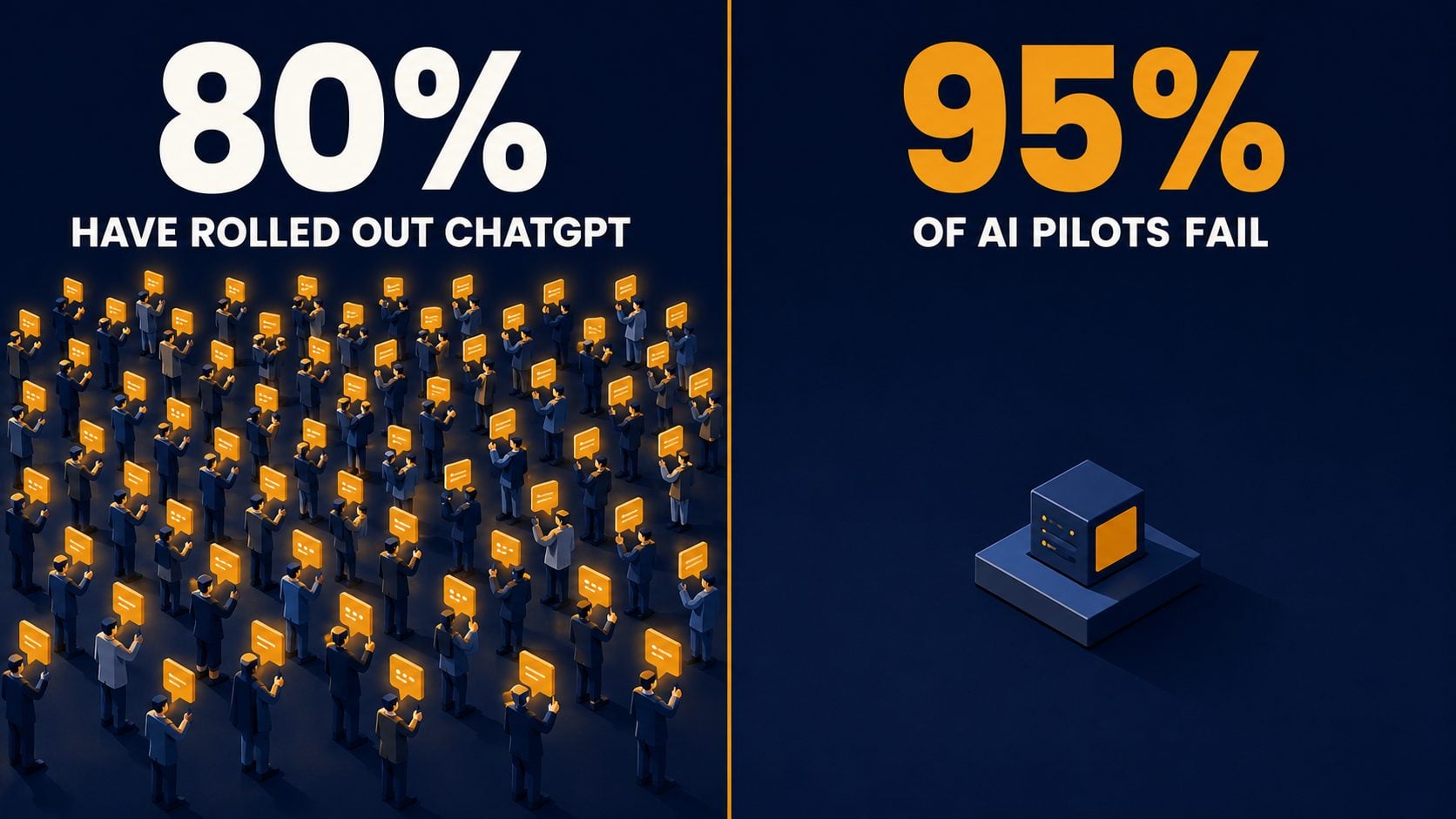
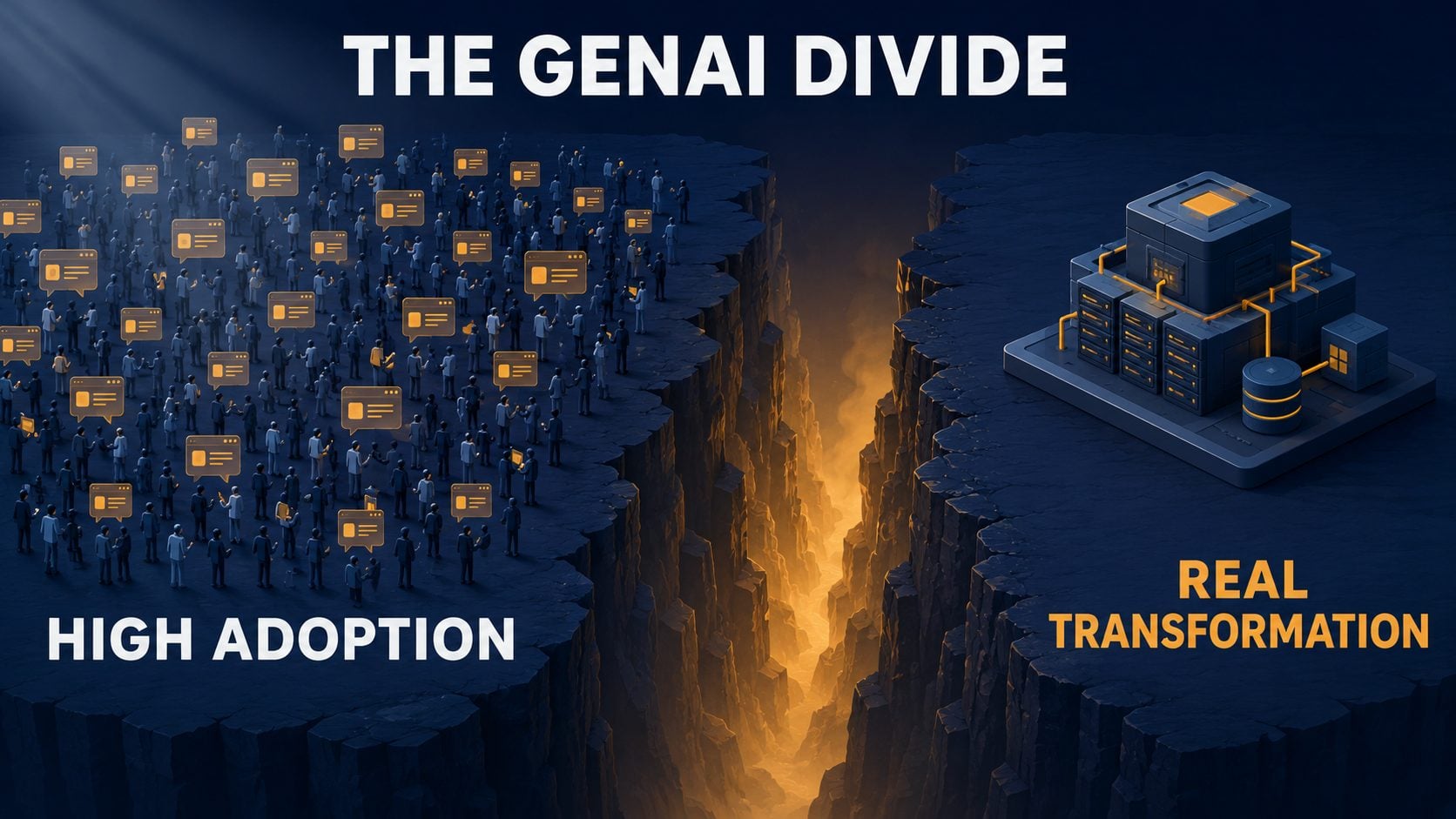
This is the gap MIT named the "GenAI Divide" — a split between high adoption and low transformation (Source: Legal.io). And for a CTO or head of automation, it raises an uncomfortable question: if you've already given your people ChatGPT and nothing fundamental has changed, what exactly were you sold — and what does the work actually require?
The honest answer is that access is not delivery, and the two are easy to confuse because both have "AI" in the name. This post is about why org-wide chatbot access is the easy 80% that produces 0% of the outcome — and what the missing piece, Forward Deployed Engineering, actually does.
What "Everyone Use ChatGPT" Actually Buys You
Let's be fair to the chatbot rollout, because it isn't worthless. Giving staff a capable general-purpose model does three real things:
It lifts individual productivity — faster drafting, summarising, brainstorming, code snippets. It builds AI literacy — people stop being afraid of the tools and start spotting opportunities. And it surfaces demand — once people taste what's possible, they ask for more.
Those are genuine benefits, and Symprio runs an Academy precisely because organisational AI literacy matters. But notice what every one of those benefits has in common: they accrue to individuals, one person at a time. None of them is a system. None survives the person logging off. And none of them changes how the business actually runs.
MIT's researchers put their finger on exactly why. Generic tools like ChatGPT excel for individuals because of their flexibility, but they stall in enterprise use since they don't learn from or adapt to workflows (Source: Fortune / Yahoo Finance). The very flexibility that makes a chatbot delightful for one knowledge worker is what makes it inert at the level of an enterprise process. It sits beside the work. It never enters it.
There's an even sharper signal buried in the data. Employees are quietly using consumer AI tools without approval — what MIT calls a "shadow AI economy" (Source: Legal.io). Read that the right way: your people have already solved the access problem on their own. Handing them an official licence mostly formalises something they were doing anyway. It is not the thing standing between you and ROI.
Why the Pilots Still Fail — It Was Never the Model
When 95% of pilots stall, the instinct is to blame the technology — the model isn't smart enough, the regulation is too tight. The research is blunt that this is wrong. The core issue is not the quality of the AI models, but the "learning gap" for both tools and organizations; while executives blame regulation or model performance, the failure points to flawed enterprise integration (Source: Fortune / Yahoo Finance).
Line up the major studies and the same culprit appears under different names:
Finding | Source |
|---|---|
95% of GenAI pilots show zero measurable P&L impact | MIT NANDA, 2025 |
42% of companies abandoned most of their AI projects in 2025 | S&P Global |
Only ~25% of AI initiatives deliver the expected ROI | IBM |
Only 21% of S&P 500 firms could cite a measurable AI benefit | Morgan Stanley |
(Sources: Terminal X, Arcast Group)
The recurring themes across all of them: poor workflow integration, the absence of a defined outcome before building started, and data that was never AI-ready (Source: SR Analytics). Every one of those is an engineering and delivery problem. Not one of them is solved by giving more people a chatbot. You cannot license your way across an integration gap.
And the bill is coming due. Organisations that launched pilots in 2023 are now in their first serious budget-review cycles — and programmes that can't show a return are being cancelled (Source: SR Analytics). "We gave everyone ChatGPT" will not survive that review.
The 5% Did Something Different
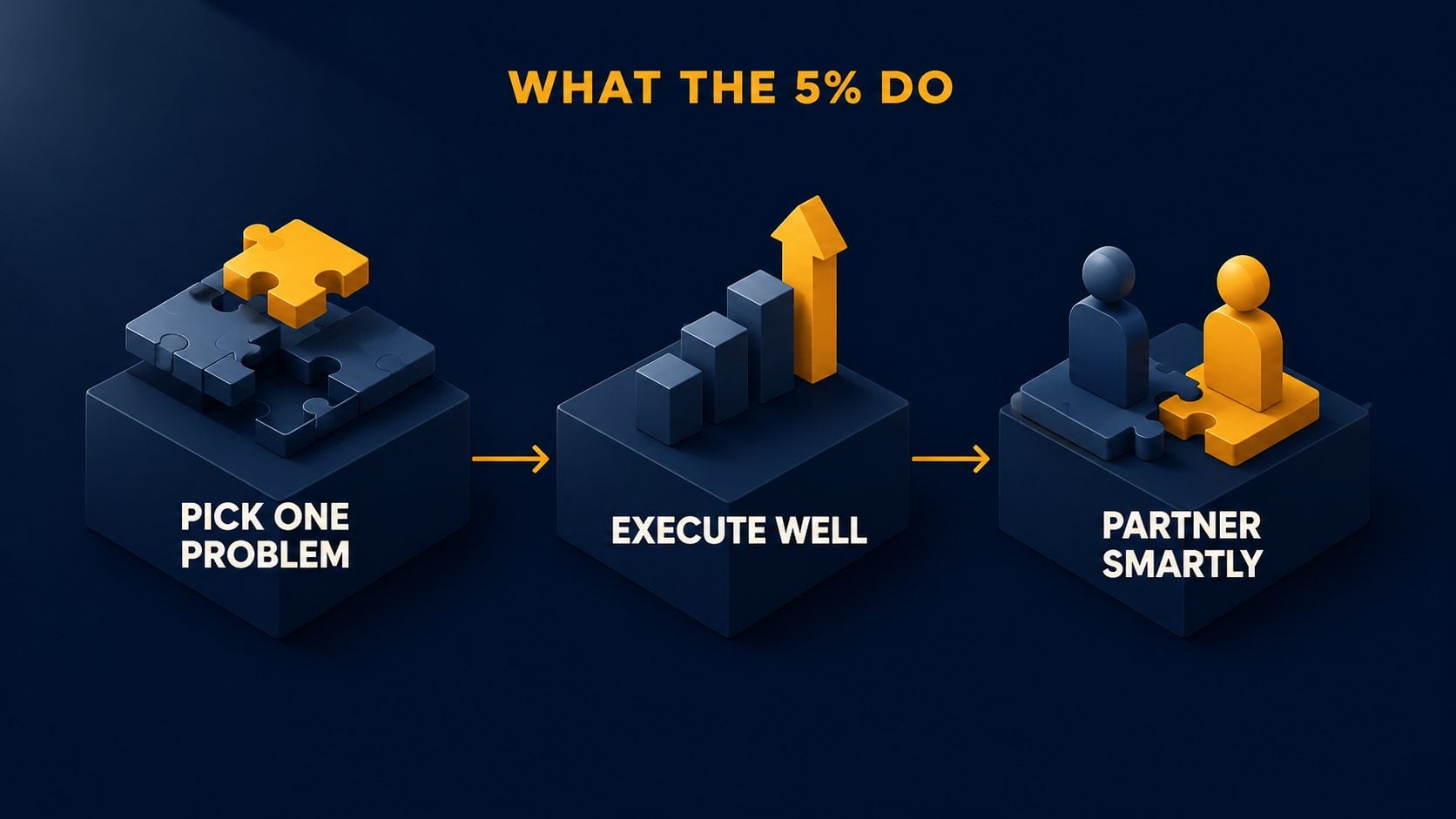
The same MIT research that found the 95% failure also studied the winners — and the pattern is remarkably consistent. The lead author described it in one sentence: the organisations that excel pick one pain point, execute well, and partner smartly with companies who use their tools (Source: Fortune / Yahoo Finance).
Read that again, because it is the entire thesis of this article. Pick one pain point. Execute well. Partner smartly. That is not a description of a software licence rolled out to ten thousand inboxes. It is a description of focused, embedded engineering against a specific business problem.
The broader research backs the shape of it. The highest AI returns sit not in the flashy, visible use cases but in back-office automation — the unglamorous processes that actually move cost and risk (Source: Trullion). And the firms pulling ahead — the JPMorgans and Capital Ones — are winning on integration into a unified data and workflow foundation, not on having a better model than everyone else (Source: Terminal X). They didn't buy smarter AI. They engineered it into the business.
That work has a name.
Forward Deployed Engineering: The Missing Discipline

Forward Deployed Engineering (FDE) is the practice of embedding engineers inside the customer's environment to build production systems against the customer's real problems — not to demo, not to advise from the outside, but to ship something that runs in the business and changes a metric.
The distinction from "everyone use ChatGPT" is total. Set them side by side:
Org-wide ChatGPT access | Forward Deployed Engineering |
|---|---|
Gives a tool to individuals | Builds a system into the organisation |
Sits beside the workflow | Runs inside the workflow |
Generic, flexible, adapts to no one | Specific, integrated, shaped to one process |
Benefit logs off with the employee | Benefit persists as production infrastructure |
Solves access | Solves integration, data, and outcome |
Produces literacy | Produces ROI |
The chatbot rollout operates at the level of the individual. FDE operates at the level of the system. That is why one shows up in 95% of companies and the other shows up in the 5% that actually get returns. They are not competing versions of the same thing — they are different kinds of thing. One is adoption. The other is delivery.
This is also why the "learning gap" MIT identified is unbridgeable by tools alone. A chatbot does not learn your loan-origination process, your claims-triage rules, or the thirty years of edge cases buried in your core system. An embedded engineer does — and then encodes that understanding into something that runs. The tool is generic by design; the engineer makes it specific by labour.
OmniFDE: Forward Deployed, Across Every Platform
The classic FDE model has one limitation: it usually arrives wedded to a single vendor's stack. The engineer is there to deploy that company's product, which means the tool gets chosen before the problem is understood — the exact inversion that the failure research warns against, where firms "start with the technology instead of the problem" (Source: Arcast Group).
OmniFDE is Symprio's vendor-neutral evolution of the model — embedded engineers fluent across Anthropic, OpenAI, Google, Microsoft, UiPath, Oracle, and open source. The principle is simple and deliberately the opposite of a product rollout: the problem picks the platform, never the reverse.
The market context is not subtle. By Symprio's own tracking of the FDE shift: 95% of pilots fail without an FDE-style delivery model, FDE job postings have grown 800%, and more than $5.5B has been committed across vendors to this way of working (Source: Symprio — OmniFDE). The industry has worked out that the bottleneck was never access to models. It was the scarcity of people who can embed, understand a specific business problem, and engineer a model into production against it.
That is the muscle the 5% have and the 95% lack. Not a better chatbot. A delivery discipline.
What This Looks Like in Practice
OmniFDE engagements are deliberately narrow at the start — one pain point, executed well, exactly as the winning pattern prescribes. Within roughly 90 days, an embedded engagement typically produces something like:
A claims-triage or loan-pre-screening workflow where an AI step is wired into the core system and measured against handling time — not a chatbot the adjuster consults on the side.
A document-to-decision pipeline that ingests unstructured inputs, applies the business's actual rules, and writes a result back into the system of record.
An agentic process that runs end-to-end across existing tools (including legacy platforms like AS/400 via an API layer) with human approval gates, audit logging, and a measurable cost or cycle-time delta.
A production observability loop so the business can prove the system is working — closing the exact measurement gap that gets pilots cancelled at budget review.
The common thread: each one targets a single defined outcome, integrates into a real workflow, and produces a number a CFO can see. That is what separates the engagement from a licence.
Verdict: Adoption Is the Easy 80%. Delivery Is the 5% That Pays.
Giving your organisation ChatGPT is a reasonable thing to do. It builds literacy, lifts individual productivity, and surfaces demand. Just don't mistake it for transformation — because the data is unambiguous that it isn't. Access is the part that's already nearly universal and nearly worthless on its own.
The returns live on the other side of the GenAI Divide, in the unglamorous work of integration, data, and outcome-focused engineering — the work the 5% do and the 95% skip. You don't cross that divide by buying more seats. You cross it by embedding people who can pick one problem, build the system, and prove the result.
That's not a tool you roll out. It's a discipline you deploy.
Engaging with Symprio

Symprio engages with engineering and automation leaders through OmniFDE in three formats:
Discovery workshop (half-day, complimentary). A working session with your senior team to find the single highest-ROI process that ChatGPT access has not fixed — and never will.
Embedded pilot (8–12 weeks). One pain point, one embedded engineer, one production system wired into a real workflow with a measurable outcome.
Long-term OmniFDE partnership. Sustained embedded capacity to build and govern an AI delivery portfolio across whichever platforms the problems demand.
Book a discovery call → · Read the OmniFDE manifesto →
Frequently Asked Questions
Is giving employees ChatGPT a bad idea?
No — it builds AI literacy, lifts individual productivity, and surfaces demand, which are all genuine benefits. The mistake is treating it as AI transformation. MIT found over 80% of firms have rolled out such tools, yet 95% of AI pilots still deliver no measurable P&L impact, because chatbots sit beside workflows rather than inside them.
Why do 95% of enterprise AI pilots fail?
According to MIT's GenAI Divide study, the cause is not model quality but a "learning gap" — flawed enterprise integration, no defined outcome before building, and data that isn't AI-ready. These are engineering and delivery problems, not access problems, so they aren't solved by giving more people a chatbot.
What is Forward Deployed Engineering (FDE)?
FDE is the practice of embedding engineers inside a customer's environment to build production systems against that customer's real problems — integrating AI into actual workflows rather than advising from outside or demoing a tool. It mirrors the pattern of the successful 5%: pick one pain point, execute well, partner smartly.
What is OmniFDE and how is it different?
OmniFDE is Symprio's vendor-neutral evolution of Forward Deployed Engineering — embedded engineers fluent across Anthropic, OpenAI, Google, Microsoft, UiPath, Oracle, and open source. Its core principle is that the problem picks the platform, rather than a vendor's product being chosen before the problem is understood.
How is this different from just buying more AI tools?
Buying tools solves access, which is rarely the real bottleneck. OmniFDE solves integration, data readiness, and outcome — embedding engineering effort into one defined business process and measuring the result. The firms seeing real AI returns win on integration into their workflows and data, not on having a better model.
Sources & Further Reading
MIT NANDA — The GenAI Divide: State of AI in Business 2025 (via Fortune / Yahoo Finance) — https://finance.yahoo.com/news/mit-report-95-generative-ai-105412686.html
Legal.io — MIT Report Finds 95% of AI Pilots Fail to Deliver ROI, Exposing "GenAI Divide" — https://www.legal.io/articles/5719519/MIT-Report-Finds-95-of-AI-Pilots-Fail-to-Deliver-ROI-Exposing-GenAI-Divide
Terminal X — AI ROI in 2026: Why Enterprise AI Fails & Works — https://www.terminal-x.ai/research/ai-roi-in-2026-why-most-enterprise-ai-fails-and-what-actually-works
Trullion — Why 95% of GenAI Projects Fail — and Why the 5% That Survive Matter — https://trullion.com/blog/why-95-of-ai-projects-fail-and-why-the-5-that-survive-matter/
SR Analytics — Why 95% of AI Projects Fail and How Data Fixes It — https://sranalytics.io/blog/why-95-of-ai-projects-fail/
Arcast Group — The ROI of AI: 75% of Projects Fail — https://www.arcastgroup.com/insights/the-roi-of-ai-75-of-projects-fail.-build-a-business-case-that-works
IBM — How to Maximize AI ROI in 2026 — https://www.ibm.com/think/insights/ai-roi
Symprio — OmniFDE: Forward Deployed. Across Every Platform. — https://www.symprio.com/omnifde
#OmniFDE #ForwardDeployedEngineering #AITransformation #EnterpriseAI #GenAIDivide #AIStrategy #Symprio #AIDelivery
Symprio builds and ships AI products in production — and embeds the engineers who make them deliver. The problem picks the platform.