Manual regression testing is the slow grind nobody enjoys — and bugs in production are the boss fight you keep losing. Here's how AI-accelerated testing changes the game, and what it actually looks like in weeks.
Let's be honest about how most teams ship software. 🎮
You grind through the level — sprint after sprint, feature after feature. Then, right before release, you hit the boss: regression testing. Someone on the QA team opens a 200-row spreadsheet of manual test cases and starts clicking through every screen, by hand, again, like they did last release and the release before that.
It's slow. It's soul-crushing. And here's the worst part — even after all that grinding, a bug still slips past you into production. The boss got a hit in. And next release? You'll be back in the exact same arena, fighting the exact same boss, by hand, all over again. In this game, that loop is expensive.
So let's talk about how you actually beat this level.
The Damage a Production Bug Does 💥
Bugs aren't just annoying — they hit your wallet harder the later you catch them.

The numbers are brutal:
A bug found in production costs up to 100× more to fix than one caught at the design stage. (Source: Qyrus)
Poor software quality cost the US economy an estimated $2.41 trillion a year. (Source: CISQ via ContextQA)
One hour of system downtime costs enterprises ~$300,000 on average. (Source: Aspire Systems)
And users? 68% will abandon an app after hitting just two bugs. (Source: CloudQA)
In banking, a broken checkout or a login loop isn't a bad review — it's a regulatory incident and a churned customer. The boss hits hard.
"Okay, So We'll Just Automate It" — Plot Twist 🌀
Every team eventually decides to automate their tests. Great instinct. Then they discover automation has its own boss fight: maintenance.
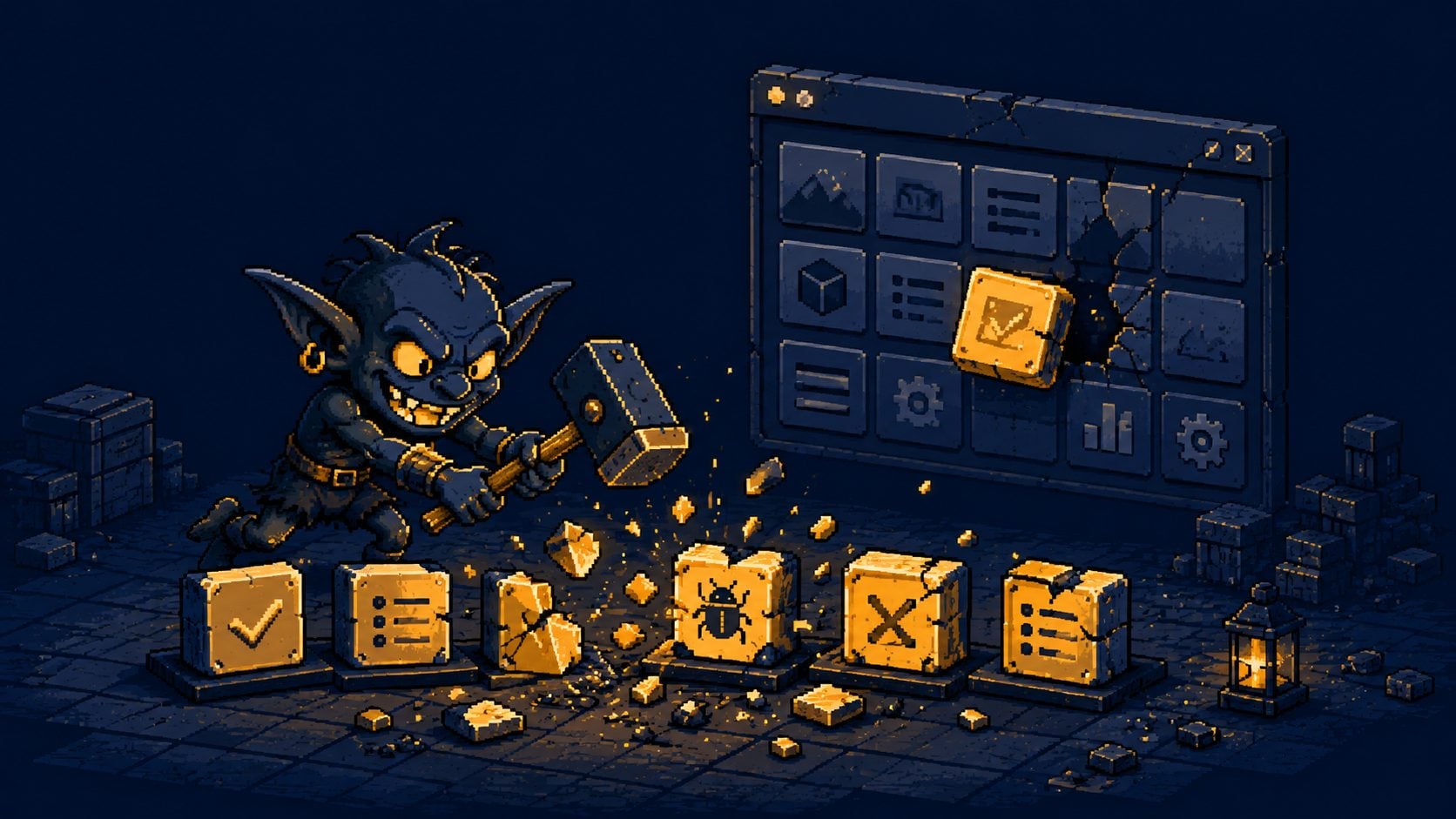
Here's the trap. You write a pile of automated tests. They work great — until someone moves a button, renames a field, or ships a new screen. Suddenly half your tests fail. Not because the software is broken, but because the tests are brittle.
These are flaky tests — and they're a plague. An estimated 15–30% of all automated test failures are flaky: failures caused by the test itself, not a real bug. (Source: CloudQA) Every one of those needs a human to investigate, confirm it's nothing, and patch the script. Do that enough times and the team quietly stops trusting the suite — which defeats the entire point.
This is the graveyard where most test automation programs die. Not because automation is wrong, but because brittle automation becomes a second full-time job.
The Power-Up: AI-Accelerated Testing ⚡
Here's where the game changes. AI doesn't replace your testers — it hands them better gear. Four power-ups, specifically:

🎁 Power-up | What it does |
|---|---|
AI test authoring | Generates draft test cases from user stories, screen recordings, and existing docs — coverage in days, not weeks of manual scripting. |
Self-healing locators | When the UI shifts, AI auto-repairs the selectors so tests survive the change instead of shattering. Goodbye, flaky-test goblin. |
Risk-based coverage | AI reads your code changes and real usage to test the journeys most likely to break first — you protect what matters. |
Automated failure triage | When a test fails, AI clusters the root cause, attaches evidence, and drafts a fix — so your team chases real defects, not noise. |
The key move: at Symprio, engineers review and harden everything the AI produces. You get the speed of AI authoring without trusting a black box with your release. Speed plus reliability — not one at the expense of the other.
Two Weapons, One Loadout: UiPath + Playwright 🗡️🛡️
There's no single "best" testing tool — there's the right tool for each layer. The strongest programs equip both:
🤖 UiPath Test Suite | 🌐 Playwright | |
|---|---|---|
Best for | Business-process & RPA validation, enterprise workflows, non-technical stakeholder visibility | Modern web app regression, cross-browser journeys, API checks, CI/CD execution |
Who uses it | QA teams, process owners, RPA CoEs, business analysts | Engineers, QA automation, DevOps, product squads |
Covers | Workflow scenarios, attended/unattended bot validation, test data | Browser journeys, network assertions, traces, multi-browser checks |
Pilot speed | 3–5 week business-process pilot | 2–4 week web regression pilot |
UiPath speaks the language of the business — claims, approvals, onboarding, bots. Playwright speaks the language of the web — Chromium, Firefox, WebKit, all three. Together they validate the whole journey, from the first click to the final database write.
One Test, the Whole Journey 🗺️
Here's the part teams underestimate: real defects hide between systems. Your web UI works. Your API works. Your database works. But the handoff between them? That's where the boss is hiding.

Instead of testing each layer in isolation, an end-to-end suite proves the complete journey works:
Web UI → APIs & Services → Business Logic → Data & Reports → RPA Bots
One test walks the entire level — the first click in the browser, all the way to the final database write and the bots in between. If something breaks in the handoff, you find it before your customer does.
Where This Lands in the Real World 🏦
This isn't theoretical. The workflows where release defects are most expensive are exactly where automated testing earns its keep:
Banking — onboarding & KYC regression. Validate onboarding forms, document-upload paths, sanctions-screening handoffs, and exception queues before every release.
Insurance — claims & policy assurance. Exercise FNOL, claims triage, policy lookup, document extraction, and payment approval across portals, bots, and backends.
ERP & Finance — Oracle/SAP testing. Validate invoice intake, approvals, 3-way match, reconciliations, and month-end release readiness.
SaaS & Portals — cross-browser regression. Cover login, permissions, payments, dashboards, and responsive behaviour across all three browser engines.
RPA CoE — bot release testing. Validate bot dependencies, credential changes, UI shifts, and downstream posting before production.
Beating the Level in Weeks, Not Months ⏱️
The best part? You don't need a year-long QA transformation to start winning. Symprio's delivery runs like a speed-run:
Stage | Time |
|---|---|
1️⃣ Test Automation Assessment | 1 week |
2️⃣ Framework & Tooling Blueprint | 1 week |
3️⃣ AI-Assisted Pilot Suite Build | 2–3 weeks |
4️⃣ Release Integration & UAT | 1–2 weeks |
5️⃣ Scale & Managed QA Automation | Ongoing |
Most clients have their first working regression suite in 2–4 weeks — turning regression cycles that took days into runs that take hours, on demand, 24/7 inside your pipeline.
That's the difference between dreading the boss fight every release… and one-shotting it. 🏆
Ready to Level Up? 🎮
Symprio designs AI-accelerated, end-to-end test automation with UiPath Test Suite and Playwright — built for the workflows that actually matter, hardened by engineers, and delivered in weeks.
Start with a pilot. A focused, AI-assisted regression suite on one high-value journey — proof of reliability in 2–4 weeks.
Then scale. Expand coverage application by application into a governed QA automation program with AI self-healing.
Explore Symprio's Automated Testing service → · Book a free consultation →
👉 See our Robotic Process Automation service → · Explore Agentic AI & LLM Solutions →
Sources & Further Reading
Qyrus — The 2026 Guide to Software Testing Cost Estimation & Reduction
ContextQA — Understanding Cost of Defects in Software Testing (CISQ $2.41T figure)
CloudQA — How Much Do Software Bugs Cost? 2025 Report (flaky tests, abandonment)
Aspire Systems — How Much Are Software Errors Costing Your Business?
Globalbit — The Real Cost of Software Bugs in Production (2026 Data)
TestDino — Bug Cost and Escape Rate Report
Symprio — Automated Testing Service
#Symprio #AutomatedTesting #TestAutomation #UiPath #Playwright #AITesting #QualityEngineering #DevOps #Malaysia
Symprio builds AI-accelerated automated testing programs for regulated enterprises across Malaysia, Singapore, India, and the USA — faster releases, stronger coverage, fewer boss fights.