UiPath FUSION 2026: RPA Grew Up
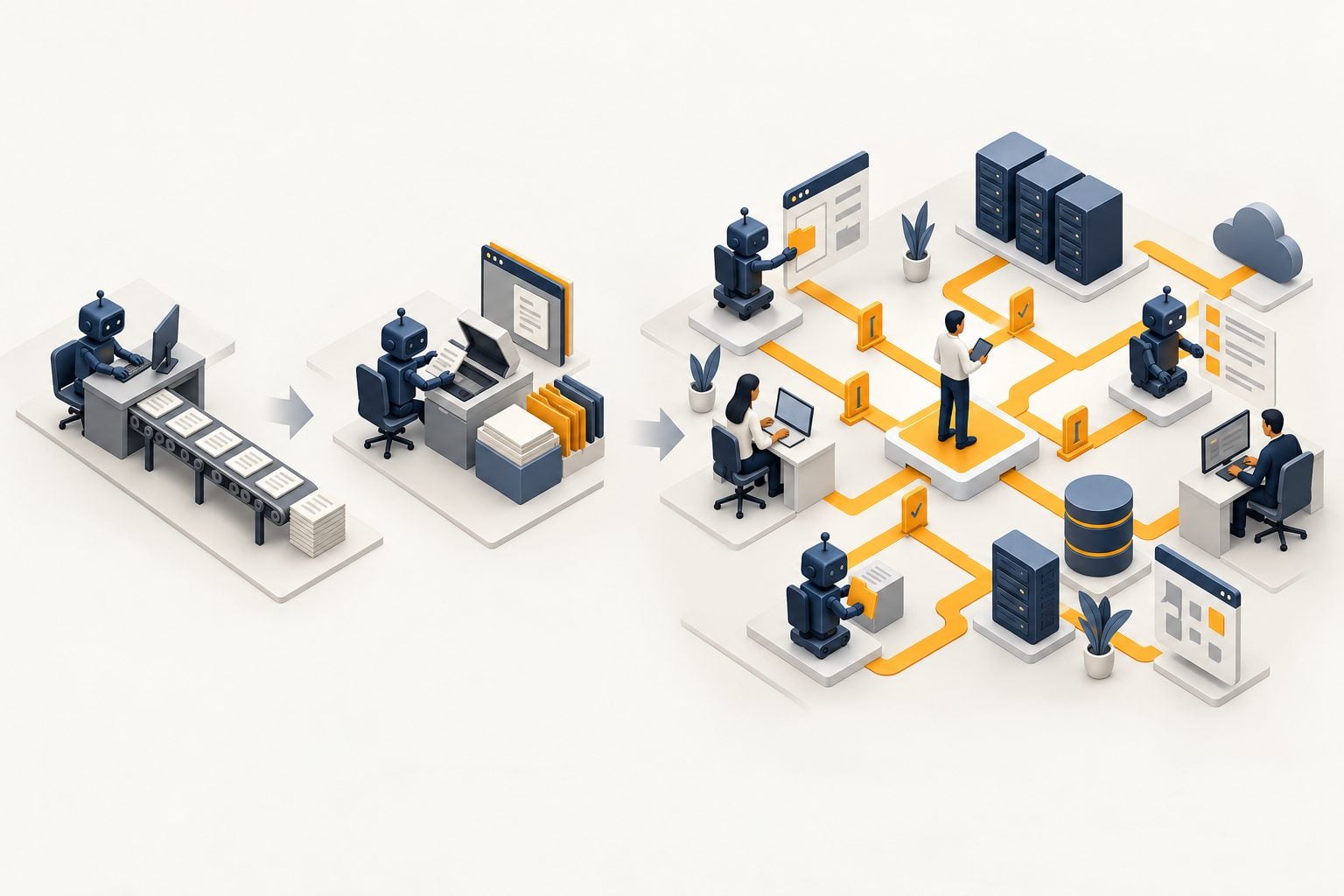
Ten years ago, "automation" meant a bot copying invoice numbers from one screen into another.
At UiPath FUSION 2026 in Las Vegas last week, the headline wasn't a faster bot. It was a map.
That shift tells you almost everything about where enterprise automation is heading. And about why the company that popularized RPA is still the one setting the agenda.
From bots to a map of how work actually runs
RPA's first era was simple. Record the clicks, replay the clicks. It worked, until the screen changed or the exception showed up.
The second era bolted on AI. Document understanding, then agents that could reason through the messy parts.
The third era, the one FUSION 2026 put on stage, is about something models can't solve by themselves: context.
"The hard part of enterprise AI is not the intelligence. It is the map." — Daniel Dines, Founder and CEO, UiPath
Dines' point is blunt. A modern model is brilliant, and it's also a stranger in your building. It doesn't know who's allowed to approve a payment, when to escalate, or what your auditor will ask for next year.
UiPath's answer is the Map of Work. It's a governed record, stored in your tenant, of how your processes actually run. It holds the rules, the exceptions, and the judgment calls your experienced people make but never write down.
The launches all hang off that idea:
UiPath Cartographer (GA) drafts and maintains the Map from documents, systems and interviews. Every fact carries its source and verifier. It ships with Process Atlas: 83 expert-attested processes across 7 industries and 25 process areas.
UiPath Delegate (GA) is a governed desktop agent. Describe a task or show it once, and it runs across your apps under enterprise identity and audit, then saves the task as a reusable routine.
UiPath for Coding Agents (GA) lets developers build workflows and tests from the approved Map using Claude Code, Cursor, Codex, Antigravity or UiPath's own agents.
Maestro splits in two: Maestro Orchestrate for long-running, cross-team processes and Maestro Automate for high-volume tasks.
A Decision Ledger (preview) records who decided what, and why, and feeds those decisions back into the Map.
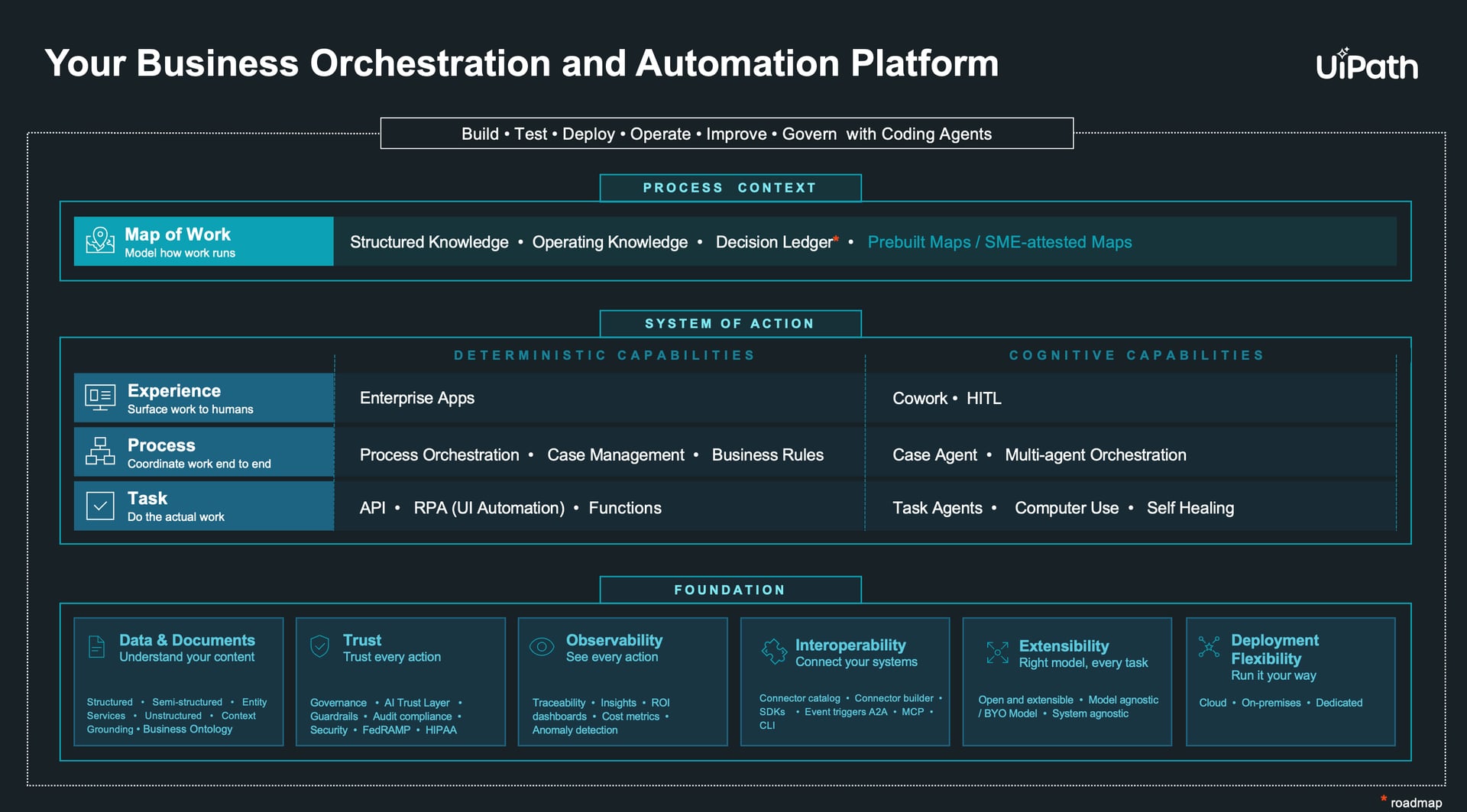
Source: UiPath
Why this is a pioneer move, not a catch-up move
Plenty of vendors are shipping agents. Very few are shipping the layer underneath them.
UiPath has been here before. It helped turn screen automation into a category, then into a public company. Now it's making the same bet again, before most of the market has caught up to the problem.
The evidence goes beyond keynote talk:
The analysts moved first. Days before FUSION, Gartner published its Magic Quadrant for Business Orchestration and Automation Technologies (BOAT) and named UiPath a Leader. (Source: UiPath) The category itself is the signal: coordinating agents, robots and people now counts as its own enterprise layer.
The customers are in production, not in pilots. UiPath named 20 winners of its 2026 GeekWire AI Breakthrough Awards, every one running agentic AI in live production with measured results. The US names on the list include BJ's Wholesale Club, United Wholesale Mortgage, USI Insurance Services, McCormick & Company, Medline and Continental Resources. (Source: UiPath Newsroom)
The governance is built in. Model Hub shows which LLMs run where. Runtime Checker validates agents while they run. LLM-as-Judge guardrails, Compliance Packs and identity policies sit on top. For regulated teams, Automation Suite on Linux now brings the full agentic stack on-premises. (Source: UiPath Newsroom)
It stays open. UiPath supports the coding agents your developers already use, including Claude Code, Cursor and Codex, rather than locking you into one model or IDE.
"The companies that do well with AI will not be the ones with the best models. They will be the ones that can say clearly how their work gets done, and let anything, human or not, act on it." — Raghu Malpani, Chief Product & Technology Officer, UiPath
We've spent years building on UiPath, and this is the first FUSION where the story wasn't about the bot. It was about the business the bot works inside. That's the right problem.
How US enterprises should adopt it
If you're a CIO, COO or Head of Automation in the US, you likely already own a UiPath estate, or you're evaluating one next to an agent platform. Here's how we'd approach FUSION 2026 in practice.
1. Don't rip anything out. Your existing bots become steps inside orchestrated processes. UiPath says it directly: every automation already in production can be called by an agent, governed by policy and seen by the people accountable for the outcome.
2. Map one high-consequence process first. Pick something with real exceptions and real audit exposure: loan origination, claims review, prior authorization, procure-to-pay. Run Cartographer on it. Start from Process Atlas or a prebuilt map if one fits.
3. Name the owner before you name the agent. Dines' own rule:
"No accountable Map owner, no agentic deployment."
If nobody will sign their name to how a process should run, it isn't ready for autonomy. For US banks, that owner is also who answers when model risk teams apply SR 11-7 style scrutiny to an agentic workflow.
4. Shadow, then gate. Let agents propose while humans decide. Use Runtime Checker and LLM-as-Judge to gate on confidence and policy. Widen autonomy only where the Decision Ledger shows consistent, explainable outcomes.
5. Hand Delegate to the business, not just IT. Delegate puts a governed agent on every desktop. That's where the long tail of manual work lives: the tasks that were never worth a full RPA build.
6. Keep your models swappable. Use Model Hub to route and track models centrally. The model you pick this quarter won't be the one you run next year. Your Map should outlive both.
Dines' sequence for all of this is five words, in order: map, build, validate, redesign, then adjust. Run it backwards and you end up automating a budget target instead of a business.
Symprio is a UiPath partner that builds agentic automation for regulated enterprises, especially financial services. We help teams map a first process, stand up governed agents on UiPath, and take them from pilot to production. If you're weighing what FUSION 2026 means for your automation program, talk to us →.
"Rent the models. Own the memory." — Daniel Dines
#UiPathFUSION #FUSION2026 #UiPath #AgenticAutomation #AgenticAI #RPA #IntelligentAutomation #BusinessOrchestration #EnterpriseAI #AIGovernance #DigitalTransformation #FinancialServices #CIO