A short story about the question every board will eventually ask — and why most companies can't answer it.
A short story about the question every board will eventually ask — and why most companies can't answer it.
Aisha had rehearsed the slide for a week.
She was the Chief Information Officer of a regional bank with four million customers, and she was standing in front of her board to deliver the line she had been building toward for two years.
"As of this quarter," she said, "we are an AI-enabled bank."
The slide behind her was clean. Copilot deployed to every employee. A customer-service chatbot handling thirty thousand conversations a month. An innovation lab with a wall of sticky notes and two data scientists hired from a tech firm. A partnership with a major AI vendor, announced in a press release that had done well on LinkedIn.
Heads nodded around the table. The chairman smiled. Aisha allowed herself a small breath of relief.
Then a board member she didn't know well, a woman who had joined from a logistics company six months earlier, raised a pen.
"I have one question," she said. "If we switched off every AI tool in the bank tomorrow morning, what would actually break?"
Aisha opened her mouth.
And found she had nothing to say.
The silence
The honest answer, she realised in the three seconds of silence that felt like thirty, was nothing.
If the chatbot went dark, the call centre would absorb the volume the way it had for twenty years. If Copilot vanished, people would write their emails slightly slower. If the innovation lab closed, two data scientists would update their LinkedIn profiles. The bank would keep running exactly as it always had.
Nothing would break. Because nothing had actually changed.
She had spent two years and a significant budget making the bank aware of AI. She had not made it run on AI. And until that board member asked the question, she had not understood there was a difference.
She gave some answer about "embedded resilience" and "human-in-the-loop design" and the meeting moved on. But the question followed her out of the room, down the lift, and into a long evening at her desk.
The diagnosis
The next week, Aisha brought in an engineer.
Not a consultant with a deck. An engineer who had spent years deploying AI inside companies, who asked to spend his first three days simply walking the floors and reading how work actually got done. He sat with the mortgage team, the fraud desk, the claims processors. He asked one question everywhere he went: show me where the AI does the work.
On the fourth day, he sat across from Aisha and told her what she already suspected.
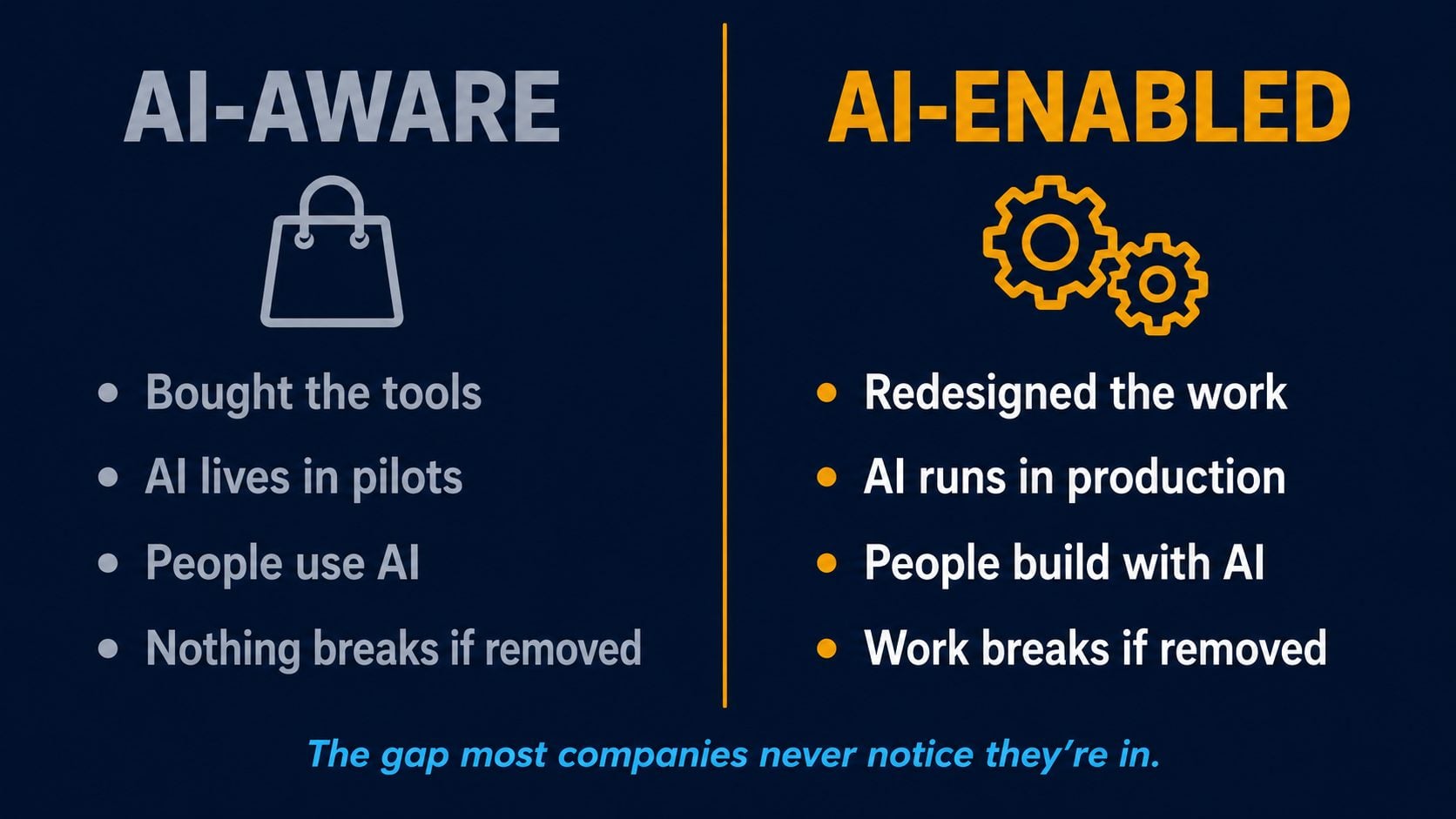
"You have an AI-aware bank," he said. "You're trying to run an AI-enabled one. They're not the same thing, and the gap between them is exactly why most of this stalls."
He told her the number that had been haunting the industry: ninety-five percent of enterprise AI pilots show no measurable business impact. Not because the models are weak. The models are extraordinary. They stall because companies bolt AI onto the surface of the organisation and never change the structure underneath.
"AI-aware," he said, "is when you've bought the tools. AI-enabled is when the work has been redesigned around them. You've done the first. You think you've done the second. Almost everyone does."
Then he showed her where the bank actually stood.
The five gaps
He walked her through it the way you'd walk someone through a building inspection. Five places where AI-aware companies discover they were never enabled at all.
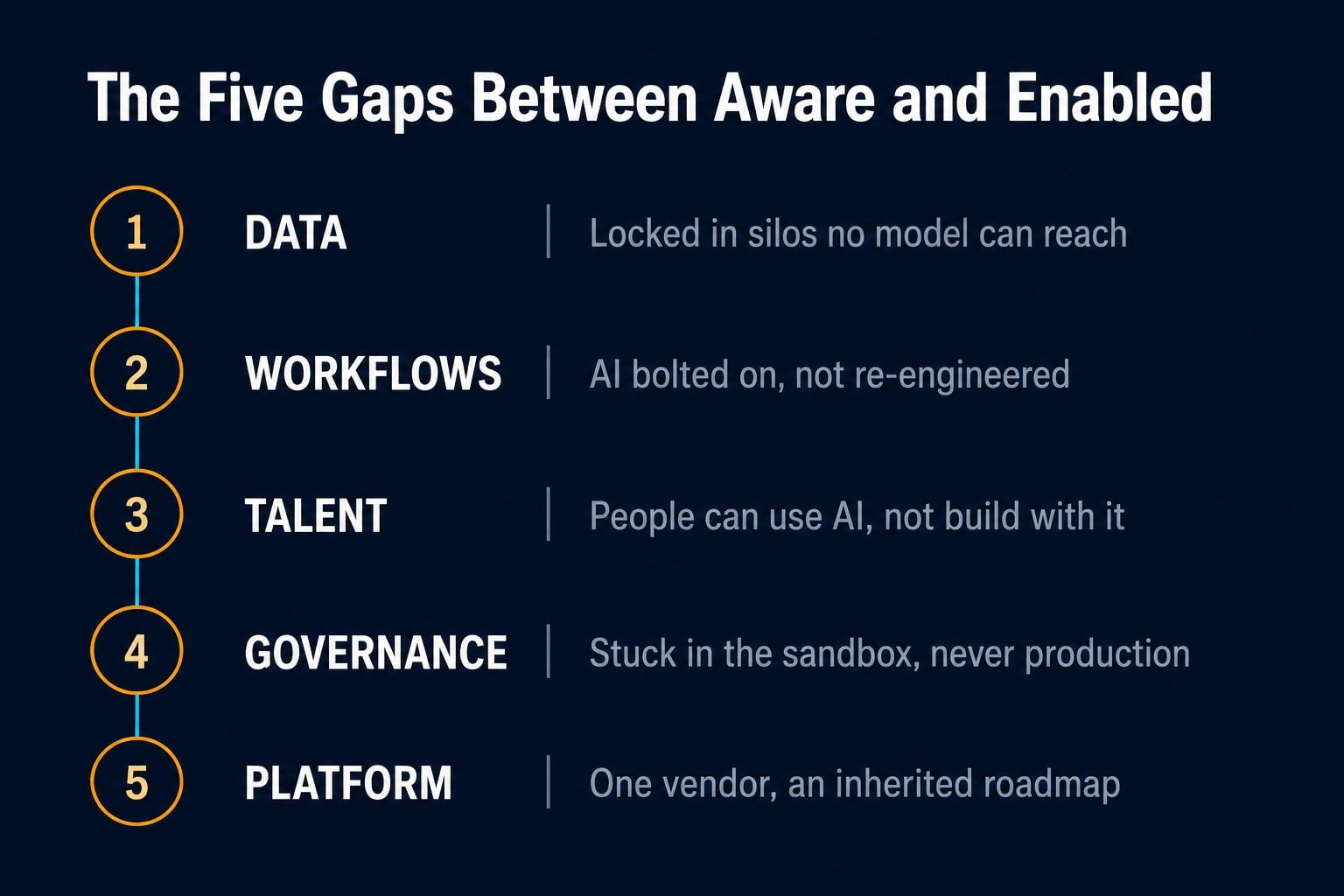
The data. The chatbot worked because someone had hand-fed it a narrow slice of FAQ content. The moment a customer asked anything real, it broke, because the bank's actual knowledge lived in forty systems that didn't speak to each other. The data wasn't AI-ready. It was barely human-ready. No model can reach what the organisation has locked in silos.
The workflows. The mortgage team had a shiny AI document-summarisation tool. They also still printed every application, because the approval process required a physical signature on page nine. The AI had been added to the process. The process had not been redesigned for the AI. So the tool sat on top of a twenty-year-old workflow like a spoiler on a tractor.
The engineer had seen this exact mistake before, a decade earlier, in the last automation wave. "When RPA arrived," he said, "everyone rushed to put software robots on top of their existing processes. The ones who failed automated the mess. They took a broken twelve-step process and made it run faster, which just meant they produced the wrong outcome at greater speed. The ones who won did the unglamorous thing first. They re-engineered the process. They challenged every step, deleted the ones that existed only because someone in 2009 had said so, and then automated what was left." He looked at the mortgage workflow on the wall. "AI is no different. Automation amplifies. It amplifies a good process and a bad process equally. You cannot AI-enable a broken workflow. You can only re-engineer it, and then enable it. Most companies skip the first half because it's slow and political, and it's the half that actually matters."
The talent. Her people could use AI. They could type into a chatbox. Almost none of them could build with it, extend it, or judge when it was wrong. The two data scientists in the lab were brilliant and completely disconnected from the teams who had the actual problems. Usage is not capability.
The governance. This was the one that scared her. Every serious AI use case the teams had proposed had died in risk review, because the bank had no framework for letting an AI system make or assist a real decision in a regulated environment. Without that, AI could never leave the sandbox. It could only ever be a demo.
The platform. And here the engineer paused, because this was the one nobody saw coming. The bank had committed everything to a single AI vendor in that press-release partnership. Every workflow they now wanted to build was being bent to fit one platform's strengths. The fraud models wanted one provider. The document work was cheaper on another. The customer-language models worked better on a third. But the bank had locked itself into one, eighteen months ago, in a decision made by people who thought they were buying a tool and were actually buying a ceiling.
"You didn't choose a platform," he said. "You inherited a roadmap. And it isn't yours."
Aisha looked at the five gaps and understood, finally, what the board member had seen in three seconds. The bank wasn't behind on AI. It was aware of AI and structurally incapable of being enabled by it. The press release had been true and meaningless at the same time.
The crossing
What followed was not a transformation programme with a name and a launch event. It was quieter than that, and harder.

They started with one workflow. Not the flashiest one. The one where the gap between effort and value was widest: the fraud-alert triage desk, where analysts drowned in false positives every single day.
They did not begin by choosing an AI model. They began the way the engineer had learned to begin in the automation years: by re-engineering the process itself. They mapped what the analysts actually did, decision by decision, and challenged each step. A third of the work, it turned out, existed only to compensate for a clumsy upstream system. They removed it. Another slice was pure rules with no judgement involved at all, the kind of deterministic, repetitive work that does not need a large language model and never did. They handed that to RPA bots, which did it reliably and cheaply. What remained was the genuinely hard part, the judgement calls on ambiguous cases, and that was where AI earned its place.
This was the lesson most AI-aware companies missed. The modern enabled workflow is not all-AI. It is a layered thing: process re-engineering strips out the waste, RPA handles the deterministic rules, AI takes the ambiguous judgement, and a human stays in the loop on the decisions that carry real risk. The bank had been trying to throw a model at the whole undifferentiated mess. The win came from separating the mess into its parts and using the right tool, including the boring proven ones, on each.
Then they wired it into the bank's real data, not a demo slice. They built the governance evidence alongside the system, so risk review was a partner from day one rather than a wall at the end. And they architected it across the two platforms that actually suited the job, instead of forcing it onto the one the bank had committed to.
Then they did the thing that mattered most. The engineer's team trained the bank's own engineers to run it, extend it, and build the next one without them. The goal was never to install a dependency. The goal was to leave.
It took ninety days for the first workflow to reach production. Real production. The kind where, if you switched it off, something would break.
Then they did it again. And the second one took half as long, because the bank now had the data foundations, the governance pattern, the trained people, and the multi-platform architecture to build on. AI-enablement, it turned out, compounded. The first crossing was the hard one. Each one after got easier.
The second board meeting
Six months after the first, Aisha stood in front of the board again. No triumphant slide this time. Just a number, and a sentence.
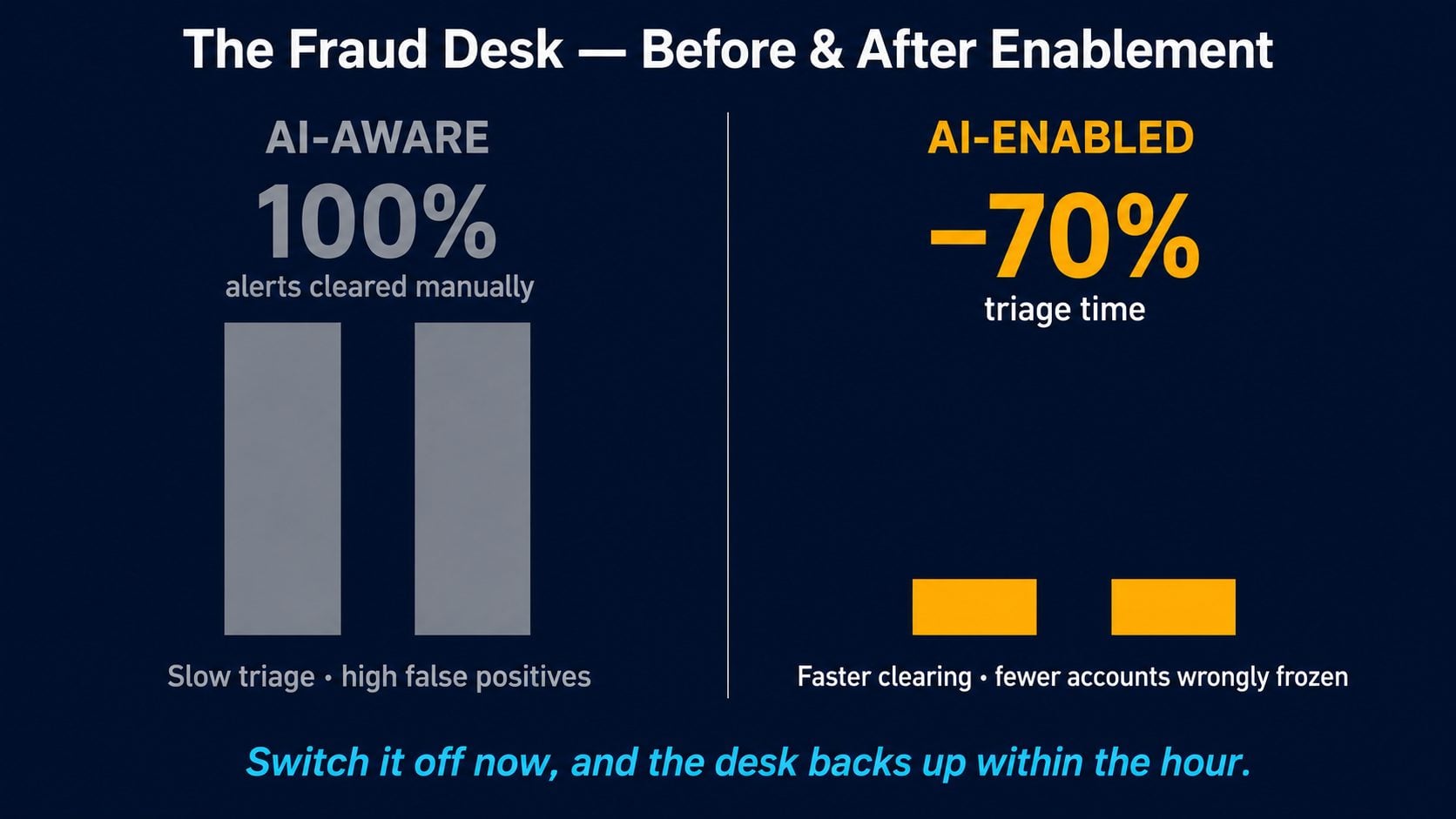
The fraud desk was clearing alerts in a fraction of the time, with fewer customers wrongly frozen out of their own accounts. Three more workflows were live behind it. And the bank's own engineers, not an outside firm, were building the fifth.
The board member from the logistics company raised her pen again. Aisha almost smiled, because she had been waiting for it.
"Same question as last time," the woman said. "If we switched off every AI tool tomorrow, what would break?"
"Now?" Aisha said. "The fraud desk would back up within an hour. Underwriting would slow by half. Three teams would not be able to do their jobs the way they do them now. We'd feel it by lunchtime, and our customers would feel it by the afternoon."
She let that sit for a moment.
"That's the difference between this year and last year. Last year, the honest answer was nothing. This year, the honest answer is a great deal. That's what it means to be AI-enabled. Not that you have the tools. That the work would break without them."

The mirror
Here is the uncomfortable part, and the reason this story is worth your ten minutes.
Most companies that believe they are AI-enabled are, today, exactly where Aisha was in the first board meeting. They have the licenses. They have the chatbot. They have the press release. And if you asked their CIO the logistics director's question, there would be the same three seconds of silence, followed by the same answer dressed up in better words.
Nothing would break.
Being AI-aware is buying the tools. Being AI-enabled is redesigning the work, readying the data, building the people, clearing the governance, and architecting across the right platforms rather than the one you happened to sign first. It is structural, not cosmetic. It is measured not by what you've deployed but by what would break if you hadn't.
And the first move is older and less glamorous than the AI conversation wants to admit: re-engineer the process before you automate it. The automation wave taught this a decade ago, and the companies repeating the "bolt it on top" mistake with AI are about to relearn it at greater expense. Automation amplifies. Make sure what you're amplifying is worth more, not just faster.
The companies that cross that gap in 2026 will pull away from the ones that don't, and the distance will not be recoverable, because AI-enablement compounds and AI-awareness does not.
So before your next board meeting, sit with the question yourself.
If you switched off every AI tool in your company tomorrow morning — what would actually break?
If the honest answer is nothing, you are not behind on AI. You are AI-aware, and you have not yet begun the part that matters.
The good news is that the crossing is a known path. It starts with one workflow, mapped honestly, rebuilt properly, and shipped into real production. That's where AI-enablement begins. Not with the tools. With the first thing that would break without them.
That first workflow is exactly what an OmniFDE discovery workshop is built to find.
Half a day with your team. We map where your work actually happens, find the one workflow where the gap between effort and value is widest, and show you what crossing from AI-aware to AI-enabled would take.
No slide deck. Just whiteboard thinking.
→ Book your OmniFDE discovery workshop Half-day. Complimentary. Whiteboard-only.
Symprio is an enterprise AI delivery practice headquartered in Kuala Lumpur, with engagements across ASEAN and global Fortune 500 clients. We build production AI across every major platform — without selling licenses, without carrying vendor quotas. We help companies cross from AI-aware to AI-enabled, then we make ourselves replaceable.
Forward Deployed. Across Every Platform.
#AIEnabled #EnterpriseAI #AITransformation #DigitalTransformation #OmniFDE #Symprio #BankingTechnology #AILeadership